


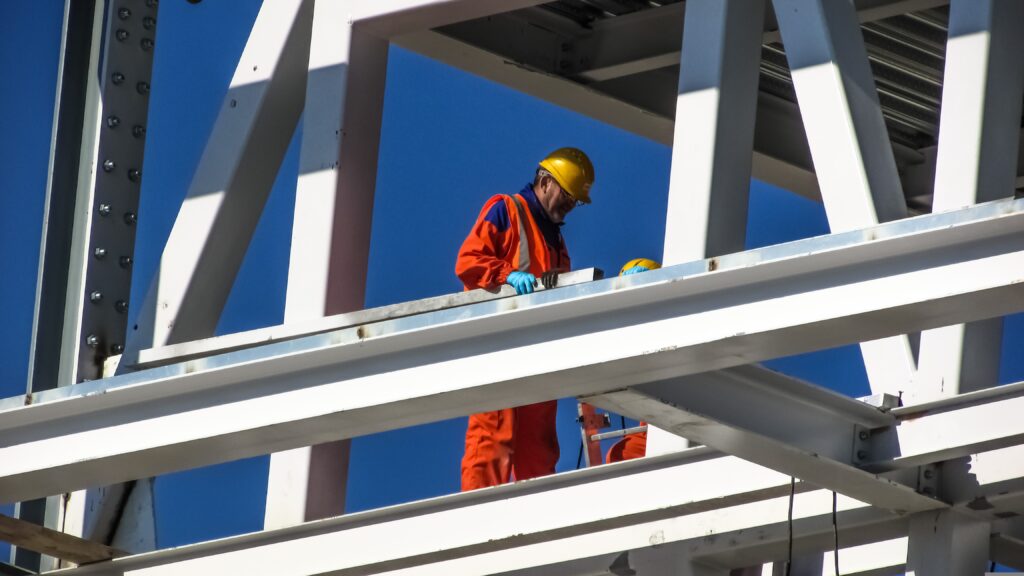
In sectors such as construction or industrial maintenance, the first question asked is when something is considered work at height. The general reference is 2 meters, but the regulations have nuances that we need to know when specifying a system, drafting a safety plan or installing collective protection in an industrial building. In this article we put these ideas in order.
What Is Work at Height
It is any task in which the worker is exposed to a fall to a lower level. Spanish regulations define the concept in Law 31/1995 on Occupational Health and Safety and in RD 1215/1997, amended by RD 2177/2004 regarding temporary work at height. It is broad legislation that covers sectors and spaces as different as a well, a trench or an opening in a floor slab.
In other words, if there is a risk of falling, there is an obligation to assess and protect against it, even if the fall is from a low height. Identifying the risks in work at height is the first step.
From What Height Is It Considered Work at Height
RD 2177/2004 establishes that, where there is a risk of falling from a height of more than two meters, work equipment must have guardrails or another collective protection system that provides equivalent safety. This regulation does not include portable ladders or technical access ladders, since they are governed by another standard.
Law 31/1995 requires assessing every fall risk, and that assessment is the first step of any work at height procedure. If a fall from a lower height can cause a serious injury, it is protected against all the same. A pit one and a half meters deep in a walkway area is a typical example.
As for guardrails, the regulations set a minimum height of 90 centimeters, sufficient strength, and intermediate protection and a toe board where needed to prevent people or objects from passing through or falling. On our ANANKE safety guardrails, for example, the toe board is required when the roof edge flashing is 100 mm or less.
What the Regulations Say About Work at Height
The framework of work at height regulations in Spain can be summarized as:
- Law 31/1995, on Occupational Health and Safety.
- RD 1215/1997 and its amendment by RD 2177/2004, on work equipment and temporary work at height.
- RD 486/1997, on workplaces.
- RD 1627/1997, for construction sites.
- RD 773/1997, on personal protective equipment.
The main idea they all share, and which is mandatory, is to prioritize collective protection over personal protection whenever possible. It is the criterion that structures the preventive measures for work at height. If the risk cannot be covered with guardrails or nets, then we must resort to personal protection.
The regulations indicate what to protect, but the protection itself has to meet a product standard. Our guardrails are tested in accordance with UNE-EN ISO 14122-3 by the independent laboratory DEKRA Testing and Certification GmbH. That test is the document requested in inspections and tenders. It does not replace the risk assessment for each project, but it gives it verifiable backing. You will find the details on our testing and certifications page.
Examples of Activities Considered Work at Height
Among the most frequent examples of work at height in our sector:
- Maintenance of industrial roofs and work on fragile roofs (sandwich panel, trapezoidal metal sheet, deck).
- Rooftop photovoltaic installations, where the perimeter and access points shape the entire project.
- Access to machines, platforms and walkways on roofs.
- Work next to skylights and roof lights, which require safety nets for skylights because translucent material cannot support a person’s weight.
- Scaffolding, facades and structural assembly.
- Wells, trenches and excavations with a risk of falling.
In every case, the decision order is the same: first, the perimeter and walkways are protected with a safety guardrail on the roof, parapet, floor or wall depending on the surface. Then, if collective protection is not feasible at a specific point, a lifeline for the section that needs it. Our entire range of solutions for work at height follows that same order.
On a new build, the system is chosen while the roof is still in progress and can be anchored directly to the structure. On an industrial building or other building already built without planning for safety, you have to adapt to what exists, and that limits the fastening options and complicates the project.
If you have a project with a roof, parapet or perimeter above 2 meters, ask us for the technical documentation and test reports for our domestically manufactured ANANKE guardrails. We advise you based on the surface, and you can request a quote with no obligation.
Frequently Asked Questions About Work at Height
As a general rule, the reference is 2 meters. When there is a risk of falling more than two meters, RD 2177/2004 requires guardrails or another equivalent collective protection system.
There is no height below which the risk disappears. The 2-meter mark is the point where collective protection becomes mandatory on work equipment. Below that, the risk assessment decides whether a fall could cause serious injury; it is protected against all the same.
When the worker is at risk of falling to a lower level, whether on a roof, scaffolding, a well or a trench. The 2-meter mark is the reference threshold, but the actual fall risk factor is determined by the specific activity.