

Protection for climbing and travel at height
Anchor systems with flexible or rigid lines, sized according to clearance height and number of workers.
We manufacture lifeline systems in Spain: horizontal, vertical, permanent, and temporary, tested and certified under current regulations.
Cable
Class
Anchor systems with flexible or rigid lines, sized according to clearance height and number of workers.
— Our systems
In our catalog we offer different solutions depending on the type of anchor, the substrate it is anchored to, and whether it is temporary or permanent.
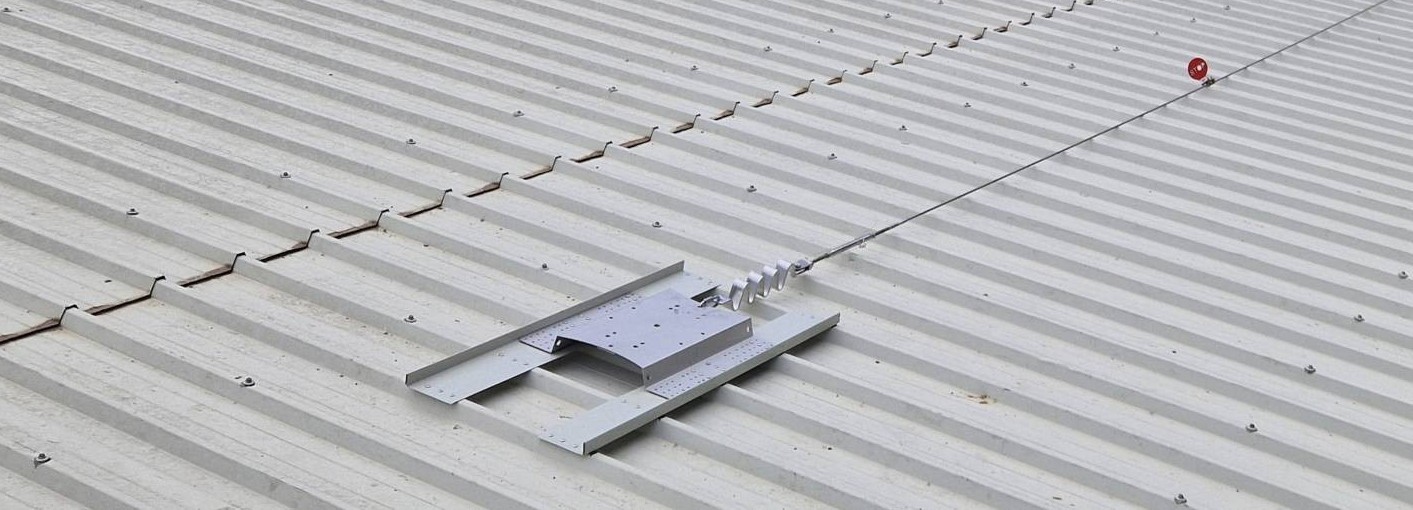
AISI 304 stainless steel anchor system for corrugated metal roofs, with an electropolished plate and waterproofing by means of neoprene and gasketed rivets. Type C certified for up to 4 users.
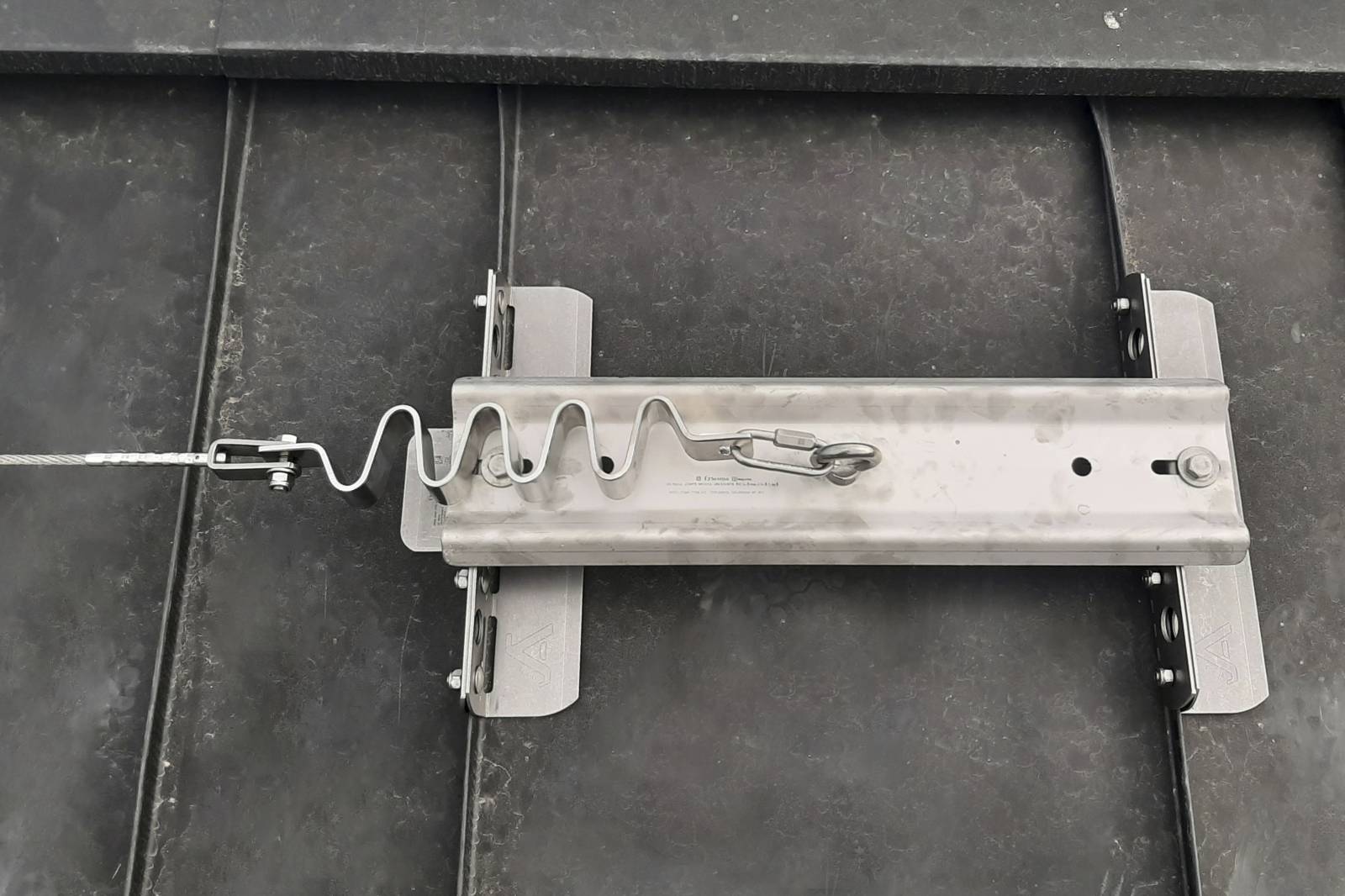
Designed specifically for installation on double standing seam metal sheet, without perforating the panel. System certified for one, two, or four people, in pickled AISI 304 stainless steel.
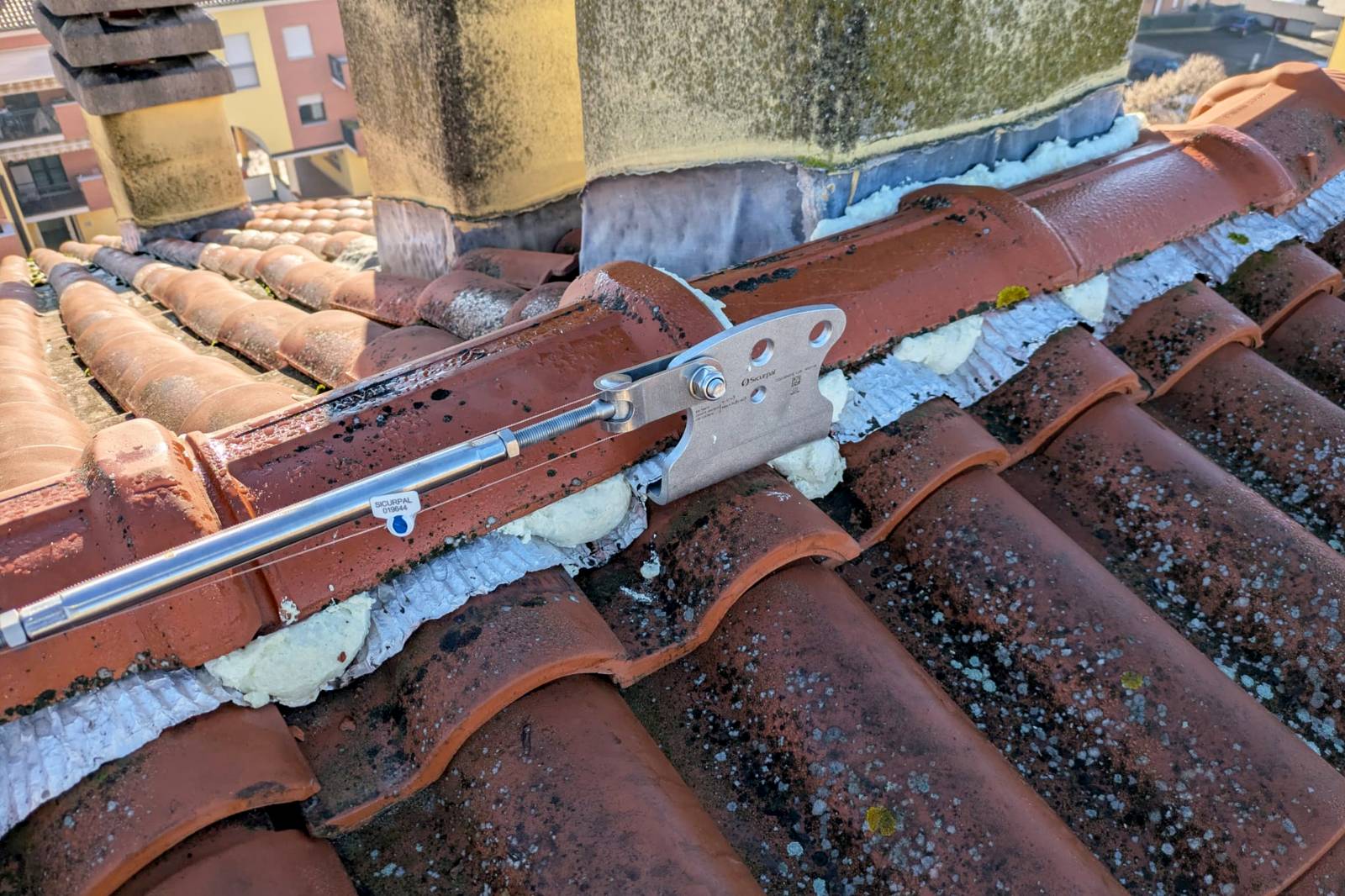
Anchor with minimal visual impact, designed for historic and distinctive buildings where aesthetics are a priority. Discreet installation at ridge level, compatible with types A and C.
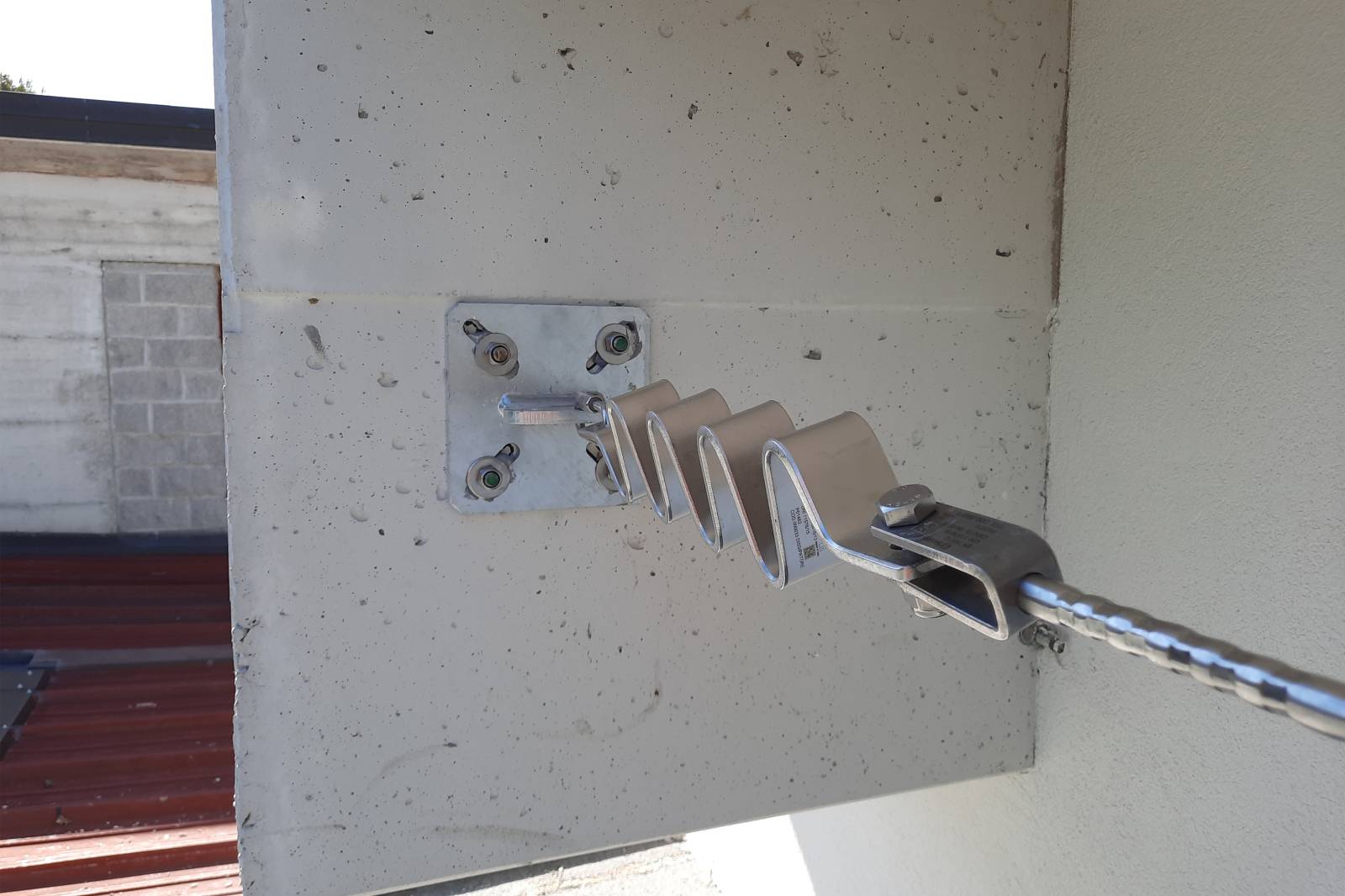
Designed specifically for installation on double standing seam metal sheet, without perforating the panel. System certified for one, two, or four people, in pickled AISI 304 stainless steel.
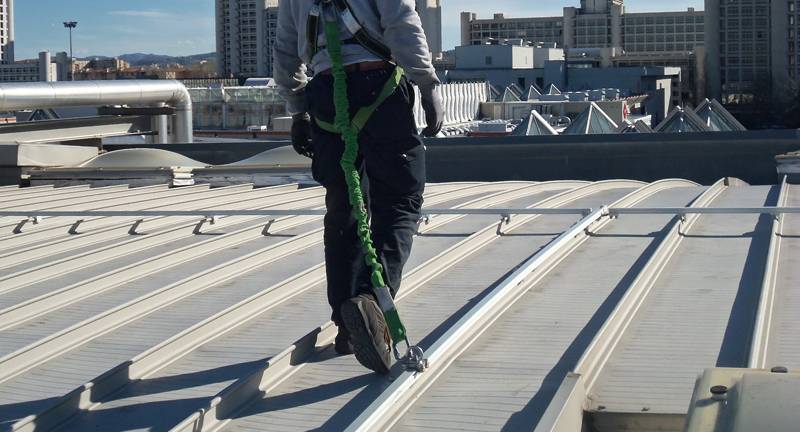
Designed specifically for installation on double standing seam metal sheet, without perforating the panel. System certified for one, two, or four people, in pickled AISI 304 stainless steel.
— What surface do you have?
The system is not chosen from a catalog; it is chosen by what is beneath the anchor. The same line, on two different substrates, requires two different fastenings.
Trapezoidal metal sheet, sandwich panel, deck roof, tile, slate, or fiber cement: each substrate requires its own fastening and load distribution beneath the finish.
Housing associations, offices, hotels, and distinctive buildings where the installation must coexist with the facade, the property, and, in many cases, low visual impact requirements.
Wind turbine towers, telecommunications, photovoltaic plants, logistics buildings, and confined spaces: long climbs where the design must also allow for rescue.
All of our production takes place in Spain. This allows us to control quality, offer tight lead times, and customize any project without extra costs.
Quote response
Shipping after quote acceptance
— How we work
From first contact to technical handover. We take care of the entire design and manufacturing cycle of the safety system.
01 / CONSULTATION
Using the height and surface data, we assess the type of access or travel required.
02 / PROJECT
We prepare the technical data sheet and a fixed-price quote.
03 / FACTORY
Testing under current regulations.
04 / JOB SITE
Installation manual, technical data sheet, and certification.
— QUOTE
Tell us about your project: surface type, meters of travel or length of the climb, clearance height below the work plane, and how many workers will be connected at the same time. We will send you back a fixed-price quote with the system sized accordingly.
Mon–Fri · 7:00 AM to 3:00 PM · Direct technical support
We will reply within 24 business hours.
It is a continuous anchor system (steel cable, rigid rail, or rope) installed on a surface or along a climb, to which the worker connects by means of a harness and lanyard. It serves to arrest a fall and limit the force transmitted to the body and the structure. It does not prevent slips or trips: what it does is stop the fall before it becomes a free fall. It is installed for work at height where perimeter collective protection is not feasible, or as a complement to it.
It is one whose components have been designed and tested in accordance with the applicable standard (UNE-EN 795 for anchor devices, UNE-EN 353 for vertical guided type fall arresters) and that comes with a declaration of conformity and an installation and user manual. It is worth distinguishing between declaring conformity and proving it: the latter requires a test report from an independent laboratory. The system is certified as a whole, not piece by piece, which is why components from different manufacturers cannot be mixed without invalidating the test backing.
It is the system installed on an industrial or building roof to allow the worker to move across the work plane with a permanent connection. It is normally horizontal, with cable tensioned between posts and intermediate continuous-pass anchors. Its design depends on the substrate (trapezoidal metal sheet, sandwich panel, deck, concrete, fiber cement) because each surface requires a different fastening and load distribution. The critical issue on a roof is the clearance height available below the plane: it determines whether the cable can work or whether a rigid rail is needed.
The regulations do not require you to install a specific lifeline: they require protection against the risk of falls from height and establish an order of priority. Collective protection (guardrails, netting…) is considered first, and only when it is not technically feasible or proves insufficient is personal protection used, which is where the lifeline comes in. In practice, the requirement arises when there is a work or access area with a risk of falling to a lower level and the perimeter cannot be protected. That assessment belongs to the project and the activity’s risk assessment, not to the manufacturer’s catalog.
It is the system installed on a sloped roof (tile, slate, metal sheet) to allow safe access and movement during maintenance. What makes it special is the anchoring: it must reach the load-bearing structure beneath the finish (purlin, rafter, or slab) without compromising the roof’s watertightness. The slope adds a variable to the calculation, because it changes the fall trajectory and the load reaching the anchor. It is never anchored to the finishing material.
The price is not calculated per linear meter, even though that is the unit it is usually requested in. It varies according to the number of anchors, the type of substrate where it will be installed, the supporting element, and the number of simultaneous users.
The classification is not academic. Each axis (direction of travel, permanence of the anchor, rigidity of the line) changes the applicable standard, the fall distance calculation, and the final price.
They allow lateral movement across the work plane. Steel cable tensioned between posts, with intermediate continuous-pass anchors so the worker can travel the whole run without disconnecting. This is the most common configuration on industrial roofs. The horizontal lifeline is governed by UNE-EN 795 in its type C.
They protect the climb, which is where the worker is most exposed: both hands occupied and free fall from the first rung. The vertical lifeline runs along the length of a fixed ladder or a tower, with a guided device that moves up with the user and locks in the event of a fall. Regulatory framework: UNE-EN 353.
A stable installation, permanently anchored to the structure and sized during the design phase. It is the right choice when access to the risk area is recurring: HVAC maintenance, exhaust systems, photovoltaics, skylight inspection. The permanent lifeline requires a logbook and annual inspection, and in return it is ready the day someone opens the hatch.
They are set up for a specific job and removed when it is finished. Transportable anchors on existing structural points, normally in a quick-to-install textile configuration. The temporary lifeline covers construction, assembly, and occasional maintenance, and is governed by UNE-EN 795 type B.
When the clearance height below the work plane is limited, cable is not suitable: under load it deflects, and that sag adds to the fall distance. The rigid aluminum rail (UNE-EN 795 type D for horizontal, UNE-EN 353-1 for vertical) deflects practically not at all. It is the solution in low-clearance buildings, mezzanines, and technical walkways, and also when the worker will be working in suspension.
The self-retracting fall arrester is not a lifeline in the strict sense, although on job sites it is often called one. It is a device that anchors at a fixed point and automatically retracts the cable, locking on sudden acceleration. It handles descent, suspension, and occasional vertical access scenarios, but it does not cover long travel across a roof or a climb up a ladder. It coexists with the lifeline; it does not replace it.
There are environments where the climb or the access defines the whole system:
It is worth clarifying this because it is a frequent error in risk assessment: a lifeline is not collective protection. It is part of a personal protection system: it only works if the worker wears a harness and a lanyard with an energy absorber and connects correctly. If they do not clip in, the system does not work.
That is why the hierarchy of controls puts collective protection first, since it protects everyone who gains access without requiring any action from the user. The lifeline comes in when that protection is not feasible, or as a complement where the work is done outside the protected perimeter.
In addition, we must keep in mind that the lifeline does not prevent the fall; what it does is stop it before it reaches the ground and limit the force transmitted to the body and the structure. That is why it is important to calculate the distance to the ground correctly, to avoid increasing the risk. ç