


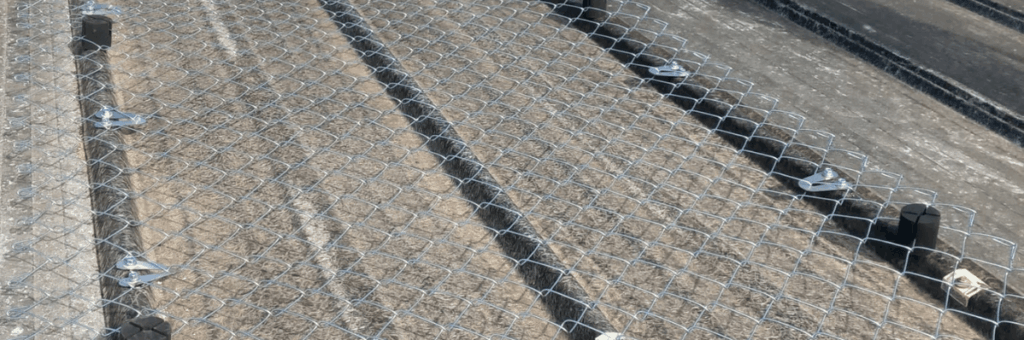
In the previous post we welcomed PIGNUS, one of YPSOS’s sub-brands. PIGNUS is the name that refers to our safety nets. In this post we will take a closer look at their features, the places where they can be installed, and the materials.
Features of PIGNUS Nets
Safety nets have many uses and can be intended for enclosures, fencing, or protection at height.
PIGNUS focuses on galvanized single-twist nets used as fall arrest systems at height.
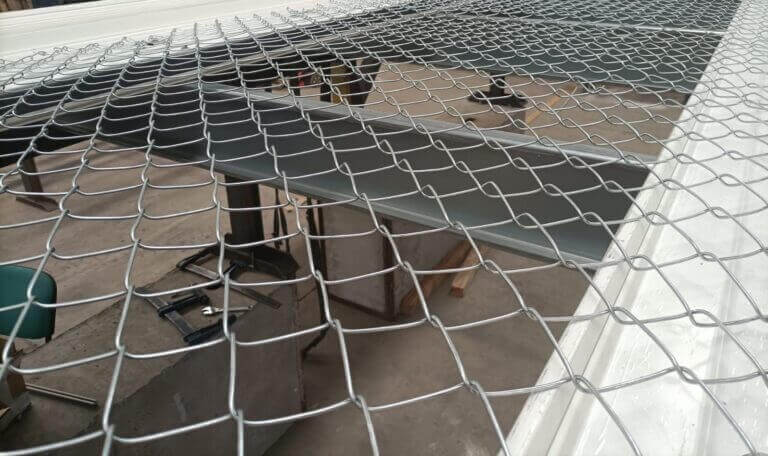
The main characteristic of this type of net is its durable and resistant material. It is generally made of wire that is subsequently galvanized, with the strands interlaced to form a diamond shape.
Another distinctive feature of safety nets designed for fall protection, when it comes to defining their strength, is the wire thickness.
The wire thickness of safety nets is one of the key factors in the event of an accident. This component determines whether or not a fall into the void occurs. In the case of PIGNUS, to guarantee safety, it offers a resistance of 1500J.
These safety devices undergo testing before their manufacture and installation, even though there is no specific standard for nets protecting translucent panels and domed skylights.
However, there is a relevant standard, specifically UNE-EN 1873:2015 on prefabricated accessories for roofing. This standard determines the product specifications and the test methods that make them safe to install.
It is important to clarify and remember that you cannot walk on these types of fall arrest safety devices, but in the event of a breakthrough, they would prevent a fall.
Where Can We Install These Safety Nets?
As we have mentioned in other posts about collective protection and referring to Law 31/95 of November 8 on Occupational Health and Safety, specifically Article 15, paragraph h), it states that measures must be adopted that give priority to collective protection over personal protection.
Safety Nets on Skylights
On this basis, skylights are installed on roofs where the aim is to make use of natural light and thus avoid excessive use of artificial lighting. This type of element is made of a translucent sheet that lets light through and illuminates the interior without using electricity.
The problem with this material is that it is not very strong and weakens over time.
With this in mind, if a repair has to be carried out on a roof and we walk on it without any personal protection system, it is very likely that, by accident, these translucent sheets will break under our body weight, causing a fall into the void.
The way to reinforce safety, and to do so collectively, is to install these safety nets over the skylight or translucent panel, thereby protecting the people who have to carry out various tasks on roofs.
We find these translucent sheets not only on roofs; there are also other sources of natural light such as domed skylights. For these elements, safety nets are used to cover their domes, thus protecting them from possible accidents.

Surfaces Where Safety Nets Can Be Installed
The materials on which we can install safety nets are varied, depending on the type of roof we encounter.
The most common installations are on sandwich panels and trapezoidal metal sheets, which are generally the most widely used materials in roof construction.
On the other hand, we also find Deck roofs, widely used in industry, on which skylights are usually placed, in this case domed skylights, which also require these collective protection systems.
In conclusion, safety nets, in this case PIGNUS, will be used as fall protection at height, specifically to protect skylights or domed rooflights.
Thanks to their durable and resistant materials, they are one of the best solutions for avoiding the risk of falling.