


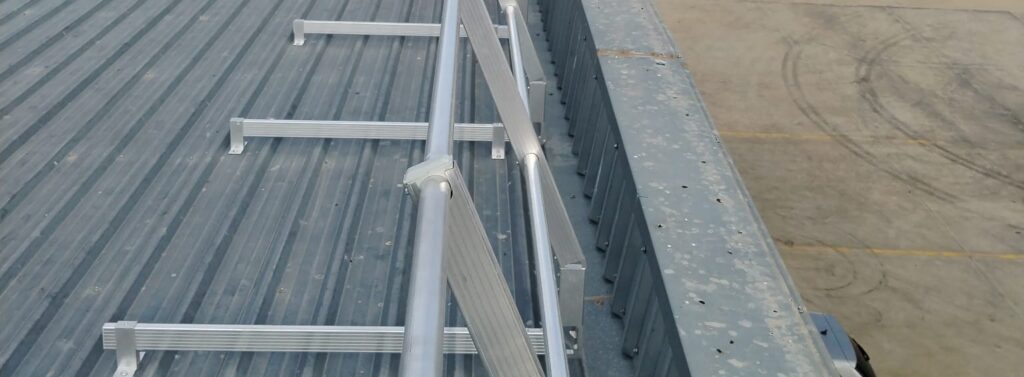
Industrial guardrails are an essential element of safety at height, installed on platforms and roofs. Beyond their design or strength, the aspect that often raises questions for installers and technicians is compliance with ISO 14122-3 depending on the slope and installation on roofs.
In this article we will talk about the standard to explain what it says and how to carry out the installation while avoiding mistakes.
What Does ISO 14122-3 Establish?
ISO 14122-3 is a European standard covering continuous, permanent access to industrial facilities and machinery, and it sets dimensions to prevent falls to a lower level. In other words, the main purpose of this standard is to protect anyone who is going to perform work at height, especially if they do so regularly.
The standard states the following:
- The minimum guardrail height must be 1100 mm from the walking surface.
- The toe board or kick plate must have a minimum height of 100 mm to prevent objects from falling.
- The gap between the top rail or handrail and the intermediate rail must not be more than 500 mm. The same applies between the toe board and the intermediate rail.
What Requirements Must Be Met on Sloped Surfaces?
- Guardrails must be installed in a vertical position relative to the floor of the structure they must protect.
- The same slope as the pitch must be maintained, ensuring at all times that the minimum height remains 1100 mm at any point along the length of the guardrail.
This is important, since a very common mistake on sloped roofs is to measure the distance completely vertically from the walking area, when it should be measured perpendicular to that area.
Avoiding installation errors will ensure that we eliminate the risk of accidents and liability in the future, in addition to complying with ISO 14122-3.
The Most Common Mistakes During Installation
When it comes to assembling guardrails, it is almost always the same mistakes that are repeated. Below we will tell you what they are and, more importantly, how to eliminate them:
Not Maintaining Height on Sloped Areas and Irregular Sections
On sloped metal roofs with sandwich panels, we usually find the same pattern or visual reference of the roof being followed, forgetting to always maintain a minimum height of 1100 mm from the walking area to the top handrail along the entire length of the guardrail, as we mentioned before.
Incorrect Distances Between Spacer Profiles
Often, in an attempt to get around pipes or objects on the roof, we tend to increase the distances between profiles, putting the strength and balance of the guardrail at risk.
Removing the Toe Board or Kick Plate
On roofs without a parapet or a minimum height of 100 mm, omitting the toe board or kick plate should never be considered, since without this piece the distance between the walking area and the intermediate rail would exceed the permitted 500 mm, falling outside the standard, in addition to the risk of falling objects that could cause an accident.
Incorrect or Incomplete Fastenings
Another type of problem we find on metal structures is missing components or insufficient hardware at the joints between profiles and kick plates, ignoring the manufacturer’s instructions and thereby removing parts that are essential for proper assembly and safety.
What Do We Recommend to Avoid These Mistakes?
To eliminate these kinds of practices or mistakes, at Ypsos Safety we recommend following a few simple steps, such as:
- Always measure the actual walking distance, making sure that on sloped surfaces the height is 1100 mm in every area of the guardrail or along its entire length.
- Check the area or surface where the guardrail will be anchored, so as to confirm the right type of guardrail and the correct anchors.
- Check the surface and handrail along their entire length to be certain that all profiles are properly joined and that there are no gaps or uneven joints.
- Do a pre-installation before fixing the entire structure. If everything is correct, proceed to the final installation using a level.
- Run your hand over the top surface or handrail to check that there are no burrs at the joints; this way we can be sure and avoid cuts or accidents when leaning on the guardrail.
Why Is It Important to Choose Systems Certified to the Standard?
The ISO 14122-3 standard ensures and meets all requirements for strength, height and safety, reducing installation time and maintenance costs of the system and preventing accidents.
In addition, it establishes minimum safety provisions or requirements for companies regarding the use of work equipment by workers.
These requirements provide for and mandate the installation of guardrails or collective protection on platforms, roofs and access points at different levels, thus preventing falls and accidents.
If after reading this post you still have questions or need advice on installing or certifying industrial guardrails according to the standard, you can contact us and we will help you with no obligation.