


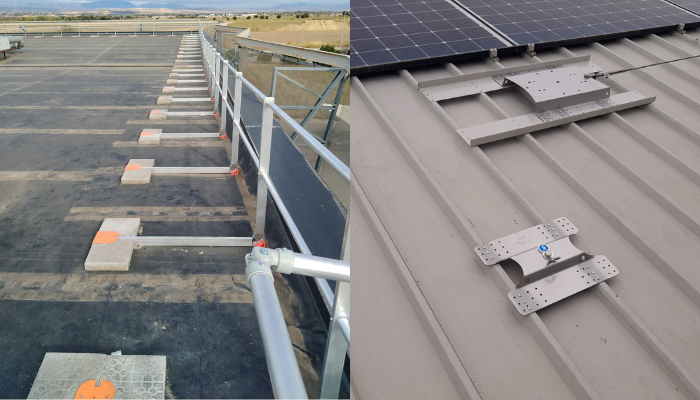
You have a closed bidding deadline and a roof with occasional maintenance access: guardrail or lifeline? The question comes up on every project that involves work at height, and the answer doesn’t depend on the installer’s preference, but on the standard and the type of task. A guardrail protects without requiring anything from the worker; a lifeline requires a harness, training, and a certified anchor point. Here are the real criteria for choosing between a guardrail and a lifeline based on your roof, how often it is accessed, and what the applicable regulations require.
Differences Between a Guardrail and a Lifeline for Work at Height
The structural difference is clear: a guardrail is collective protection and a lifeline is personal protection. A safety guardrail is installed once, covers the entire perimeter of the roof, and does not depend on the worker wearing personal protective equipment (PPE) or using it correctly. A fall arrest system with a lifeline, on the other hand, only works if the worker wears an approved harness, with its lanyard, connected to an anchor that complies with the relevant standard.
For work at height with frequent access, such as HVAC maintenance, photovoltaic panel inspection, or gutter cleaning, a guardrail is usually the most recommended option, since it requires no extra equipment or specific training. A perimeter guardrail does not solve movement across the interior of the roof. For those cases, and for one-off tasks that don’t justify a fixed collective protection system, the solution is a lifeline.
Collective or Personal Protection: What the Standard Says
The preventive hierarchy is set by Article 4 of RD 486/1997, which requires giving priority to collective protection over personal protection whenever it is technically feasible. For a walkable roof, the first option to consider in the project is the guardrail, not the lifeline. The standard governing the design and testing of guardrails is UNE-EN 14122-3. Lifelines, for their part, are governed by the EN 795 standard, with variants depending on the type of anchor device.
This regulatory difference explains why both solutions coexist on many projects: the guardrail takes care of the perimeter, and the difference between collective and personal protection shifts to the lifeline for the points the guardrail doesn’t reach.
When to Choose an Edge or Roof Guardrail
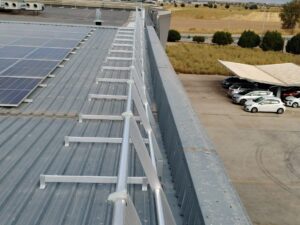
A safety guardrail is the most efficient solution when the roof is walkable and the edge is the point of risk, as would be the case with fragile roofs such as sandwich panel, trapezoidal metal sheet, or deck. The type of fastening depends on the surface: counterweighted when the roof cannot be drilled, or fixed to the sheet or to the floor when anchoring is permitted. The structure of the guardrail is the same in all configurations, bearing in mind that it must have a minimum height of 1100 mm, a handrail and an intermediate rail, with a maximum gap between them of 500 mm, and a toe board if the roof upstand is 100 mm or less.
When the risk is concentrated on the perimeter and not in the interior of the roof, installing edge protection guardrails solves the task without having to train personnel in the use of PPE or manage harness or lifeline expiration dates.
When a Lifeline Is Necessary
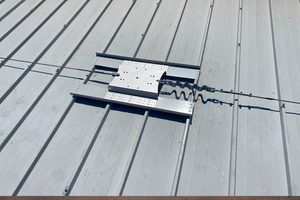
As we mentioned, the lifeline comes into play when a guardrail is not feasible or does not cover the entire route, whether for movement across the interior of a roof with skylights, for occasional maintenance of photovoltaic or wind installations, or for occasional access where a fixed collective protection system is not justified. In these cases, the system must be backed by testing from an independent laboratory and have the certification that proves its strength in accordance with the applicable anchor standard and as stated in the manufacturer’s manual.
It is the option when the worker needs to move through an area without perimeter protection. We should not resort to a lifeline when it is feasible to install a guardrail; doing so for budgetary reasons undermines the preventive hierarchy. In addition, both systems can coexist on the same roof, increasing the protection of workers.
Do I Need a Lifeline If I Already Have a Guardrail?
It depends on whether the guardrail covers the entire walkable perimeter or only part of it. If there are guardrails along the entire edge and the worker does not need to leave that protected zone, no additional lifeline is needed: the collective protection already addresses the fall risk. You need one when there are roof sections without a guardrail, such as access to HVAC units, walkways to solar panels, or areas with obstacles, where the worker has to move outside the protected area.
Neither the guardrail nor the lifeline eliminates the risk on its own; their function is to reduce the likelihood of a fall and, if they are tested and certified, they make it possible to demonstrate that the installation complies with the regulations required in the project.
Perimeter Guardrails vs. Roof Lifelines
On a roof, the perimeter guardrail provides complete edge protection and is the option that any occupational health and safety professional considers first at the project stage. The lifeline is reserved for movement across the interior, between photovoltaic panels, next to skylights, or on roofs with multiple obstacles, where a continuous guardrail is not feasible because of design or cost.
In bids and contracts where the solution has to be justified to the end client, having technical documentation for both systems, with testing, certification, and domestic manufacturing, makes specification easier and avoids delays in project approval.
How to Choose the Right Solution for Your Project
The final decision depends on three factors: the type of roof and its installation surface, how often personnel will access it, and what the project or bid documentation requires. If access is frequent and the perimeter is walkable, the guardrail solves the problem with less management. If the risk is in the interior of the roof or access is occasional, the lifeline is the technical option.
At Ypsos we manufacture and test both systems in our own workshop, backed by an independent laboratory. If you have a specific project, request a quote or the technical documentation and we will help you define the solution before the deadline closes.
A lifeline is necessary when a guardrail is not feasible or does not cover the entire route, such as for movement across the interior of a roof with skylights, occasional maintenance of photovoltaic or wind installations, occasional access, or sections without a guardrail, such as access to HVAC units or areas with obstacles, always giving priority to collective protection over personal protection under Article 4 of RD 486/1997; if the guardrail already covers the entire walkable perimeter, no additional lifeline is needed.