


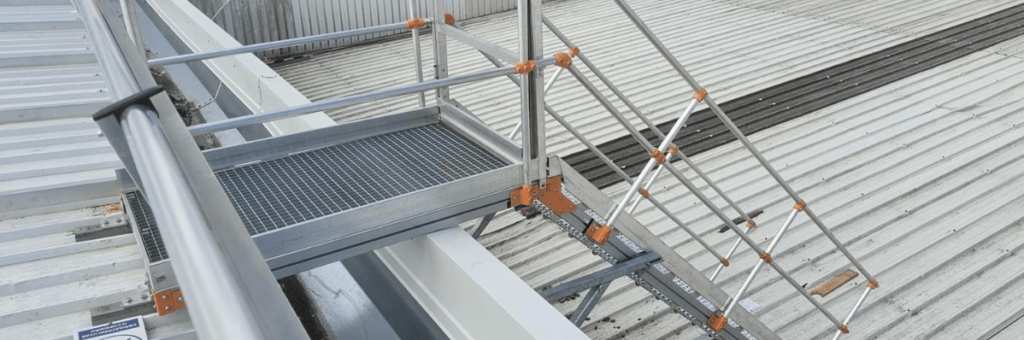
When designing industrial ladders there are several very important aspects to take into account so that they can be used in a completely safe way. This process must always be carried out by an expert professional specialized in it.
Types of Industrial Ladders
Among the safety systems on the market there are different types of ladders, including industrial ladders, which cover different types depending on the environment where they will be installed and their use. Among them we can find the following:
- Fixed vertical ladders: Also known as “ladder-type” access, these are systems usually fixed to walls or industrial structures. They are commonly used to climb up to roofs, silos, towers, or machinery located at height.
- Fixed inclined ladders: These systems incorporate an angle, most commonly between 45° and 60°, and are suitable for frequent access to platforms or maintenance areas.
- Portable or mobile ladders: These are ladders for temporary use; they are light and versatile and intended for occasional jobs where they need to be removed after use.
What Aspects Must Be Considered to Design a Safe Industrial Ladder?
Among the types of metal ladders mentioned there are standardized models, but where standard solutions fall short, we will have to turn to custom-designed systems; the design will depend on the intended use, frequency of use, and the environment where it will be installed.
Ladders intended for frequent use will be designed with a permanent structure, with non-slip rungs, conduits, and strong anchors; otherwise, if these systems are used only occasionally, portable ladders or mobile platforms will be chosen.
Regarding their dimensions and ergonomics, the UNE EN ISO 14122-4 standard sets out a series of guidelines that we must take into account when manufacturing them, such as:
- Support surface.
- Clear width.
- Distance between side rails.
Another important point is that, when ladders exceed 3 meters in height, it is mandatory to include a fall arrest system, such as safety cages, vertical lifelines, or retractable devices; this will depend on each project.
For heights greater than 6 meters or 10 meters, we will add landings every 6-meter section to make the route easier for users and reduce fatigue.
Focusing on the fastenings of these safety systems, we must fix them with bolts and anchor points at most every 2 meters; this ensures the stability of the ladder, and sometimes other elements will need to be added to give the structure stability.
To choose the material properly, we must take into account the environment where we will install it; depending on the environment, we will choose the appropriate material, such as aluminum, galvanized steel, stainless steel, or even fiberglass-reinforced plastic (FRP).
Which Standards Govern Industrial Ladders and What Do They Require?
On the regulatory side, several standards apply to ladders, including the following:
- EN 131 standard: Applicable to stepladders, telescopic ladders, ladders with platform, or articulated ladders; within this standard we can find its design and strength criteria, such as:
- Maximum load of 150 kg.
- Single-user use.
- Must include visible marking.
- Use pictograms.
- Instructions for use, including warnings.
- UNE EN ISO 14122 standard: This standard governs fixed means of access to machinery or structures; two of its parts apply to ladders. Part 1 sets the criteria for choosing between ladders, ramps, and platforms. Part 4 contains the design and manufacturing criteria, such as dimensions, back protection, fall arrest devices, and specific conditions for the profiles.
What Common Mistakes Should Be Avoided When Designing or Installing an Industrial Ladder?
In both the design and installation of ladders we can find mistakes that lead to future problems, especially regarding safety. Among these mistakes, the most common are the following:
- Fall arrest systems: Sometimes, through their absence or incorrect installation, we increase the risk of falling.
- Maintenance: Height safety does not end with the installation of the system; it goes further. Even if a system is well designed and installed, a lack of maintenance can lead to dangerous situations such as rust, breakage, and insufficiently tightened fasteners.
- Error in choosing the system: Another very common mistake is not choosing the right type of ladder for our project; to avoid this, we will carry out a proper risk assessment beforehand.
- Exceeding maximum loads: Another problem that compromises the safety of the system is improper use, with users carrying excess tools or even adding more weight to the system than it should bear.
- Incorrect inclination or fixing on unstable surfaces: This can cause the system to tip over.
Conclusions
Designing safe access ladders involves integrating the criteria of the current industrial ladder standards and taking the intended use into account in order to select the appropriate system. At Ypsos Safety we do not just manufacture ladders; we handle the entire process, from design and validation of the system’s strength to installation by qualified personnel with the proper training from the manufacturer. We collaborate with companies that have the right professionals to ensure solutions that truly comply with the regulations and guarantee safety.