


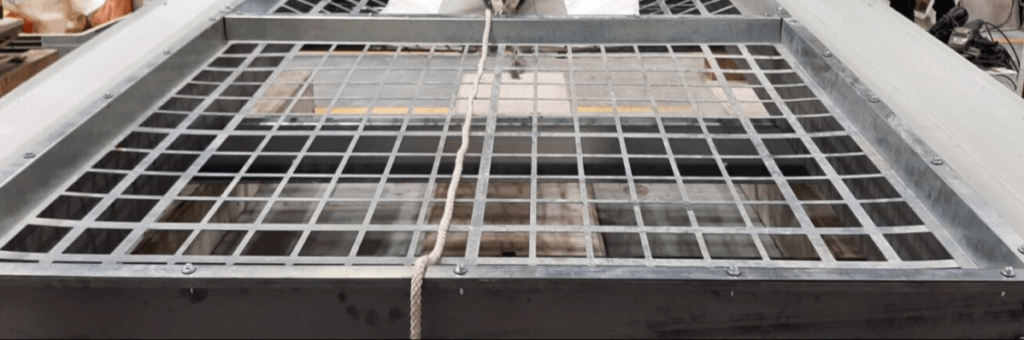
In the following post we will talk about testing in general, what it is, and what purpose it serves in the manufacture of fall protection devices. We will also go deeper into the importance of complying with the standards for that testing.
Specifically, we will explain the procedure we follow at Ypsos Safety when testing our products. In this case we will focus on testing of PIGNUS, the name that refers to our skylight protection safety nets.
What Is Product Testing?
Product testing is a set of measurement processes through which we check whether our products meet all the requirements to be placed on the market safely.
The main aspects assessed in those measurements are:
- The properties of the products
- Safety
- Quality
- Compliance with the current standards under which they are manufactured and tested.
Throughout our posts we have been naming different standards that refer to how products are manufactured.
Well, there are also specific standards on how to test them. Many of those on manufacturing requirements contain some aspect about testing. Others are simply complemented by another standard more focused on the tests themselves.
Purpose of Testing a Product
There are two purposes when testing products:
- Complying with the current standards that set out the manufacturing requirements the products must meet. This results in safe products.
- Subjecting them to their most unfavorable situations to verify that even in those most extreme cases, the products respond appropriately. This is how we guarantee their effectiveness, safety, and purpose.
Importance of Complying with Standards
If each of us could manufacture products by our own criteria, it is very likely that some important aspect would be overlooked, which could lead to unsafe products, accidents, etc.
This is why UNE, EN, and ISO standards, among others, are created. They unify the different criteria in a single document and result in a safe market. In them, all these aspects can be consulted so that we can all know which requirements to follow for safe manufacturing.
How Do We Test PIGNUS at Ypsos Safety?
Applying all this information to our PIGNUS brand, the first thing to point out is that there is no specific standard that dictates how skylight protection nets must be manufactured or tested.
In this case, there are parallel standards that refer to the applications of these products as safety elements and that must be subjected to testing to verify their safety.
The standard UNE-EN-1873 Prefabricated accessories for roofing. Individual rooflights of plastics material. Product specification and test methods. is the reference standard for laboratory testing, and although it does not directly mention protection nets, it is the one used to carry them out.

At Ypsos Safety, besides a declaration of conformity as manufacturers, we test our nets externally at an accredited laboratory.
These tests take into account the materials used in developing our nets and their strength, including the fixings used and all their elements. This guarantees that all of them have the necessary strength and durability so that neither the weather nor the passage of time deteriorates the materials, resulting in a safe product. All the environments where they may be installed are taken into account.
Before the laboratory test, PIGNUS nets undergo measurements at our facilities, using the necessary measuring instruments to carry out these tests. Once the result of our own test has been checked, the samples are sent to the laboratory.
Our test is carried out at 1500 J, which gives our products greater safety in case of an accident, since the usual tests are at 1200 J.
At Ypsos Safety we take into consideration both the quality of our products and their safety.