



In work at height, it is essential to use personal protective equipment that is specific to these tasks and properly certified, because of the great risk and danger of working on top of a structure. To ensure the worker’s safety, it is not enough to put on just any harness or helmet; any PPE used must comply with current regulations.
In this article we explain, in summary form, how to tell whether PPE is properly certified for work at height, which regulations must be taken into account, and how to interpret them correctly.
What Standards Must PPE for Work at Height Meet?
Regulation (EU) 2016/425 defines PPE as:
“Any equipment designed to be worn or held by a person for protection against one or more risks to that person’s health or safety at work.”
In the context of work at height, the most common PPE includes fall arrest harnesses, ropes, connectors (carabiners), fall arrest devices, energy absorbers, safety helmets, and others.
For PPE to be legally marketed and used within the European Union (and in countries that follow the same regulations), the following basic conditions must be met:
- CE marking: Indicates that the product meets the requirements of Regulation (EU) 2016/425.
- Conformity assessment: The product must have been assessed by a notified body.
- Technical documentation available: Instructions, declaration of conformity, and certificates.
- Compliance with harmonized standards (EN): Specific to each type of equipment.
Regulation (EU) 2016/425: Legal Basis
This European regulation sets out the essential requirements that PPE must meet. It has been mandatory since April 2018 and replaced the former Directive 89/686/EEC.
In Article 8, the Regulation establishes:
“The manufacturer shall ensure that the appropriate conformity assessment procedure […] has been carried out and shall keep the technical documentation and the EU declaration of conformity for ten years.”
And Annex II details the essential health and safety requirements, such as:
- Resistance to mechanical stress.
- Compatibility with other equipment.
- Legible and durable marking.
Technical Standards Applicable to Work at Height
A very practical way to tell whether PPE is certified for work at height is to check whether it complies with the applicable harmonized European standards (EN). These standards set the technical requirements, testing, and labeling for each type of equipment that must be used. The most important ones are summarized below:
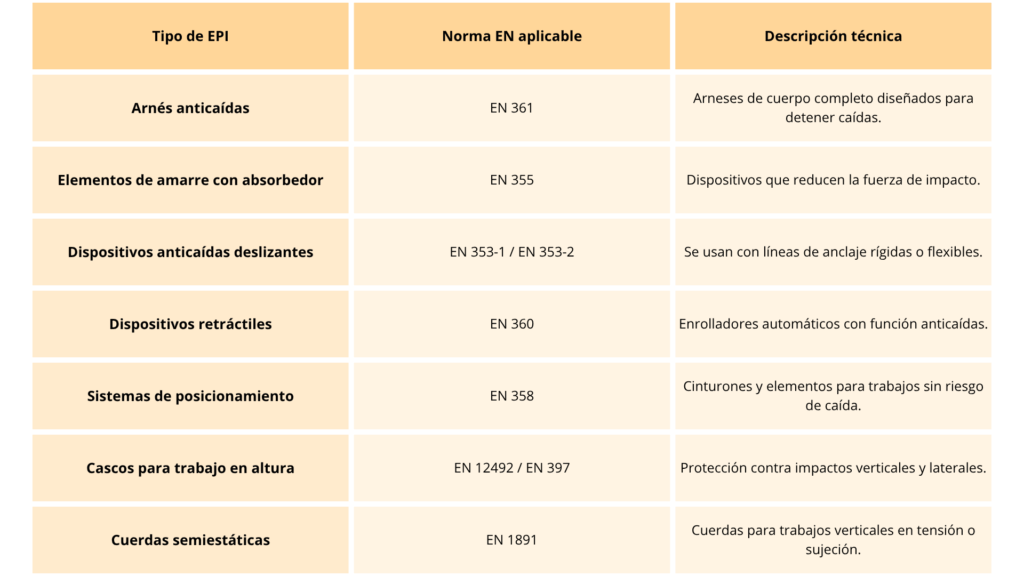
When PPE meets one of these standards, this must be clearly indicated on the label of the product and in its technical documentation.
What Documentation Should Come with Certified PPE?
Notified Bodies and Certification
Notified bodies are organizations accredited by EU member states to assess the conformity of PPE. The number of the body appears next to the CE marking on Category III equipment, such as equipment intended for protection against falls from height.
EU Declaration of Conformity
The manufacturer must provide an EU declaration of conformity, which may be supplied in physical or digital format (via QR code or web link). This document includes:
- Manufacturer details.
- PPE identification.
- Applicable standards.
- Notified body details.
- Date and signature of the responsible person.
This declaration is essential to demonstrate that the PPE has been tested and assessed in accordance with Regulation (EU) 2016/425.
Instruction Manual
All PPE must be accompanied by an instruction manual in the official language of the country of use, stating:
- How to use it.
- Maintenance and cleaning.
- Estimated service life.
- Warnings and limitations.
- Test results.
This document must be kept as part of the technical documentation of both the employer and the worker.
How Can You Verify That PPE Certification Is Valid?
PPE Labeling: What to Look For
All PPE must carry a legible, indelible label attached to the equipment, with the following information:
- CE marking (followed by the notified body number if applicable, for example CE 0197).
- EN standard it meets (for example, EN 361:2002).
- Manufacturer’s name or brand.
- Product model or reference.
- Serial or batch number.
- Year and month of manufacture.
- Explanatory pictograms or warnings.
- Basic instructions for use.
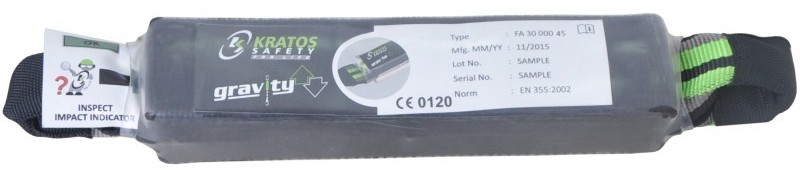
If any of this information is missing, the product may not be properly certified.
Further Considerations to Keep in Mind
- PPE service life: Some PPE has a limited service life (usually 5 to 10 years). It must not be used once this date has passed, even if it has never been used. This must be specified by the manufacturer.
- Periodic inspections: All PPE must be inspected at least once a year by a competent person, and before each use by the user.
- Compatibility between equipment: PPE used together must be compatible (harness + line + connector), and this must be verified with the manufacturer or supplier.
Conclusion
You must check that PPE is certified not only for safety, but also for legal compliance. Checking that it has the CE marking, that it meets the applicable EN standards, that all of its documentation is in order, and that a notified body was involved is essential for working with peace of mind, and it is what shows that the equipment is fit to protect workers’ lives. It is not enough for PPE to look professional; it must be properly tested, approved, and documented in accordance with current regulations.
That is why, whenever PPE is to be purchased or inspected, you must make sure to carry out these checks, which will make the difference between safe work and an accident.
We hope this article gives you a general idea of what CE marking is and what implications it has for both workers and the general public. If you need more information, don’t hesitate to contact us; we will be happy to help.