


What Are Crossovers and What Are They Used For?
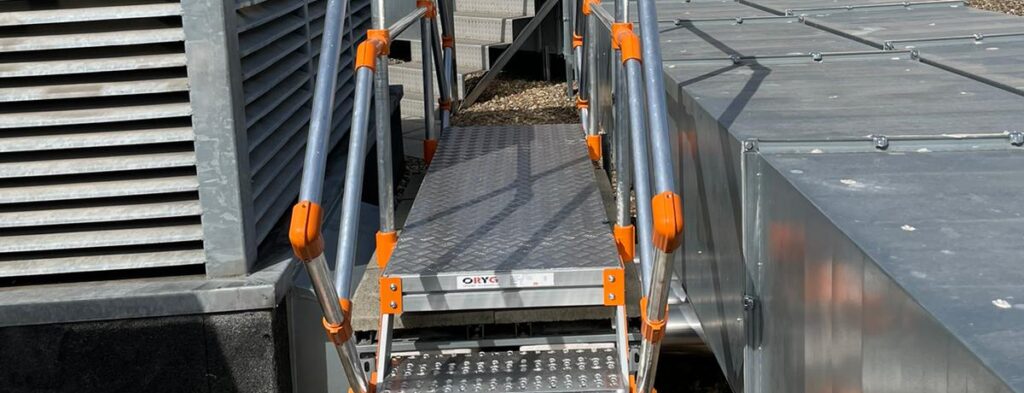
Crossovers are modular metal structures designed and manufactured to ensure safe passage in areas where it is common to encounter obstacles that can pose a risk for work at height. They are commonly installed in:
- Roofs.
- Factories.
- Access to machinery.
- Situations with level differences.
- Places where we may find ducts, pipes, cooling systems, etc.
Their function is to ensure continuous passage across these systems, thereby reducing the risk of a fall or accident. In addition, installing them lets us improve the routes workers have to take in their regular tasks, thereby optimizing working times.
Why Is It Important for These Crossovers to Be Custom-Made?
One of the most common questions about crossovers is why there are no standard solutions for this type of safety system, as there are for other types of systems. The answer is that no two projects are ever the same. There are so many differences from one type of project to another that it would be impossible to have a standard solution that fits each client’s specific needs, so to ensure safety at height and regulatory compliance, we have to turn to these custom solutions.
To design the system, we have to consider the following aspects:
- Size of the obstacle to be crossed: We will take into account the width, length, and height of the obstacles.
- Type of roof we are working on: Depending on the material, the system must be anchored in one way or another.
- Frequency of use of the crossover: Depending on whether it will be used occasionally or regularly.
- Environmental factors: We will consider exposure to the elements and the installation area for possible corrosion effects, etc. The choice of materials will depend on this.
- Existing safety elements, or those installed together with the new system: It is important to consider whether this system will work independently or together with other safety systems so that it can be adapted to them.
Taking all of these aspects into account, we will proceed with the design and manufacture of the crossovers. Considering all of this not only helps produce a safe system, it also ensures compliance with current regulations. In this case, EN 14122 on permanent means of access to machinery will apply.
What Key Points Should Be Considered for Correct Installation?
For a correct crossover installation, there are several aspects we need to consider, which will ensure its functionality and that it is a durable system. Some of these aspects are the following:
- Risk assessment: Before designing and manufacturing the crossover or its equivalents, we will carry out a proper risk assessment. In it we will measure the obstacles or access points to be created, and note the type of roof, the installation location, whether there is a risk of corrosion from the environment, electrical risk, the types of loads to be supported, the number of users, the frequency of use, and other aspects that help us design the right safety system for the particularities of each project.
- Standard compliance: Both its design and its manufacture will take into account the criteria of the EN 14122 standard.
- Anchors: As mentioned above, the crossover must be anchored with fixings suited to each type of roof or surface. We will also make sure to apply the correct tightening torque so that the stability of the system is not compromised.
- Drainage areas: When designing it, we will make sure the walkway does not block water drainage areas and that there is no possibility of water pooling on it.
- System protection: To avoid premature deterioration, we will consider the environment and the type of industry where the crossover will be installed, and with that we will choose the material or treatment suited to each circumstance.
What Does Ypsos Recommend When Installing Crossovers?
To ensure adequate safety on roofs, at machine access points, or in any risk situation we need to bridge, at Ypsos Safety we recommend taking the following aspects into account for correct installation of walkways:
- Plan ahead.
- Follow all of the manufacturer’s recommendations, and make correct use of its manuals and the documentation provided.
- Properly train the installation personnel.
- Carry out the periodic maintenance specified by the manufacturers and keep proper records of it.
Conclusion
Crossovers are a versatile safety element that can adapt to any situation thanks to their custom manufacturing. With them we ensure continuous, safe passage for workers, reducing the risk of accidents and improving the productivity of each plant. However, they must be installed correctly for the result to be a truly effective safety system.
Working with duly qualified manufacturers and personnel gives us an appropriate solution and ensures we are supported throughout the entire process, from design to installation.
If you still have any questions, or are interested in purchasing or installing this type of crossover, don’t hesitate to contact us with no obligation.