


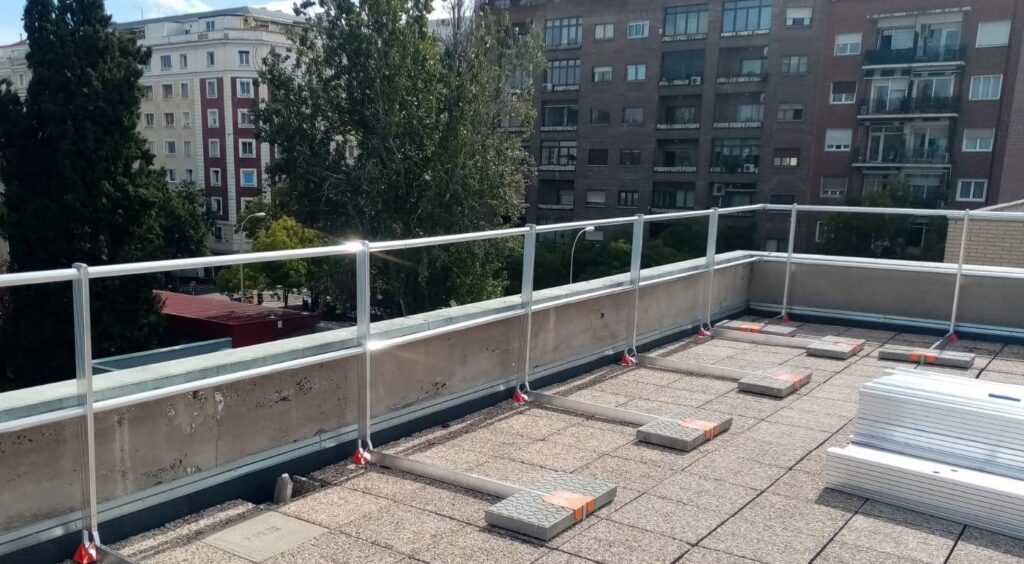
Today we will talk about what to do when a renovation or modification is carried out on a roof that already has collective protection installed, specifically perimeter protection guardrails. Nowadays it is very common to carry out renovations, modifications or repairs on the roof for various reasons, such as waterproofing it due to loss of watertightness, installing solar panels, expanding or modifying HVAC installations, or even renovations to change the use of roofs and turn them into leisure areas, etc.
We will focus on building roofs, since renovations are less frequent on industrial buildings, although what we cover can be applied there as well with the specifications of their applicable regulations.
What Regulations Govern the Reuse of Guardrails on Roofs?
We will focus mainly on:
- Law 38/1999, on Building Regulation (LOE), requires that buildings, in their design, construction, maintenance, upkeep, use and interventions, must meet the basic building requirements, including safety and structural safety.
- Technical Building Code (CTE), approved by RD 314/2006 and amended (for example, by RD 732/2019). In particular:
- Basic Document DB-SE (“Structural Safety”) and more specifically DB‑SE‑AE Actions in Building, which regulates the forces that parapets, guardrails, balustrades, etc. must withstand.
- Basic Document DB‑SUA (“Safety in Use and Accessibility”), which regulates safety against falls, minimum height, openings, climbability criteria, etc.
- UNE/UNE‑EN standards for testing, guardrail design, strength, material quality, etc., for example UNE 85‑238‑91 (guardrails: horizontal thrust test method) and others such as 14122-3 and 13374
- Law 31/1995, of November 8, on occupational health and safety and its implementing regulations such as RD 486/1997, RD 1215/1997 and RD 1627/1997.
Can a Guardrail Be Reinstalled After the Renovation?
Suppose we have to carry out a renovation on the roof of our building and for that we have to remove the existing protections, specifically the perimeter protection guardrails. The question that arises once the renovation is finished is whether we can reinstall the old guardrails, and the answer is yes, but with caveats.
It is possible to reuse a guardrail, but only if it meets the current legal requirements for structure as well as safety, strength, geometry, height, etc.; otherwise, reusing it may be illegal or unsafe. Logically, we cannot reuse a guardrail or any occupational safety equipment, especially to prevent risks of falls from height, if it has been used and deformed to prevent a person from falling, that is, if an accident has occurred and the collective protection has had to act. In that case we cannot use the same guardrail; the affected section must be removed, where possible, and replaced with a new one.
Let us remember that guardrails are manufactured according to the requirements set out in the applicable UNE-EN standard and, therefore, compliance with those requirements must be verified and maintained
Factors That Determine Whether a Guardrail Can Be Reused
Depending on the renovation carried out on a roof, several circumstances may change that affect the validity of the guardrail and, therefore, its safety:
Change in the Use of the Roof
If the roof goes from being “non-walkable” (access for maintenance only) to “walkable” for regular use, a terrace, etc., then the guardrail needs to meet more demanding standards: greater horizontal forces, higher heights, safety requirements against falls.
Change in Loads, Geometry or Slopes
If load is added (for example new paving, planters, furniture), the slope is changed, or another material is installed that changes weight, stiffness, etc., this can affect the structural capacity of the guardrail or its fastening, and it may even be necessary to change the type of guardrail because the new roof cannot be drilled.
Alteration of the Perimeter or Edges
The shape of the edge where the guardrail sits, the height of the finished floor level, the alignment… can all be modified, and all of this can change the level difference being protected, which implies a different minimum protection height requirement.
Stricter Current Regulations or Legislative Changes
If the guardrail was installed under older regulations, a renovation may mean that the current requirement is now higher and the guardrail no longer meets it. In addition, when work is carried out, the LOE comes into play, requiring that in interventions on existing buildings the basic conditions already in place not be reduced if they are less demanding than those of the CTE.
Cases Where a Guardrail Can Be Reused
An existing guardrail can be kept if:
- After a technical inspection it is verified that it meets all current requirements applicable to the present use and the use the roof will have (for example, use category, possibility of foot traffic, level difference, public / private).
- Its structure, materials, anchors, state of corrosion and fasteners show no structural defects, significant deterioration, permanent deformation or loss of strength.
- The height of the guardrail is the minimum required for the current situation after the renovation, or higher. For example: if the roof ends up with a level difference of more than 6 m relative to the ground, the minimum height will be 1.10 m. If the level difference is smaller, 0.90 m. (According to DB‑SUA CTE)
- The gaps between balusters or other elements do not allow a sphere of about 10 cm to pass (the usual CTE SUA rule to prevent children’s heads from getting through) and there are no elements that make climbing easy.
- The guardrail withstands the horizontal loads required for the use category, in accordance with DB‑SE‑AE. For example, in residential use, normally 0.8 kN/m; in cases of greater occupancy or for accessible roofs used by people, more may be required.
In Which Cases Should It Not Be Reused?
- It shows structural deterioration (corrosion, fatigue, defective welds, cracks) so that the strength or stability requirements are not met.
- If the height is less than that required for the new situation after the renovation and it cannot be adapted.
- If the anchors or the base structure cannot ensure adequate fastening with the new configuration (for example, if the support or base, or the edge materials, have been modified).
- If the use changes to a more demanding one and the guardrail does not meet the required load category.
- If the gaps create risks of falling or climbing, or do not meet the safety requirements for use (minors, accessibility, etc.).
We have mentioned it in earlier paragraphs, but a fundamental aspect in deciding whether an existing guardrail can be reused will be the result of the inspections carried out; in some cases these will be visual only, and in others they will require laboratory tests and trials.
Inspections That Can Be Carried Out
Thorough Visual Inspection
- Condition of materials: oxidation, corrosion, wear, deformation, cracks, welds.
- Condition of the supports / anchors to the slab, structure, edge: whether there is corrosion or breakage, detachment, slipping.
- Check whether there has been impact damage, degradation from weathering, or problems with fasteners.
Geometry Measurement
- Actual clear height: from finished floor level to the top edge of the guardrail.
- Gaps between balusters or other elements: must meet the CTE limit (normally for a 10 cm sphere or other criterion).
- Check for protrusions or “climbable” elements that make climbing easy.
Strength Test
- Horizontal thrust test: apply a uniform horizontal load according to DB‑SE‑AE and the use category and measure deformation, strength and possible residual deformation. Example: standard UNE 85‑238‑91. Stiffness verification: that it does not deform excessively and no dangerous movements occur.
Verification of the Load-Bearing Capacity of the Support / Structure
- That the structure to which the guardrail is fixed (slab, roof edge, parapet, metal profile, etc.) has sufficient strength.
- Verify that the transmitted load or the support conditions have not been modified after the renovation.
Review of Specific Applicable Regulations
- Check that the applicable UNE / UNE‑EN / UNE‑EN ISO standards are met (materials, glass, profiles, anti-corrosion treatments, etc.).
- Confirm that there are no particular restrictions, such as municipal rules, heritage protection or local ordinances requiring specific standards.
Documentation and Certification
- Have the original documentation for the guardrail, if available: specifications, tests, quality certificates.
- If there is none, carry out on-site tests and issue a technical report signed by a competent technician justifying the reuse.
If the result of the above inspections shows that the existing guardrail does not meet the requirements and cannot be adapted or corrected at a reasonable cost, the following should be considered:
- Complete replacement with a new system that meets the CTE and the relevant UNE standards, designed for the new situation of the roof.
- Partial adaptation: reinforce the anchors, increase the height with extensions, add intermediate protection element(s), replace degraded materials.
- Installation of a new edge parapet if the guardrail was only partial or lightweight, and a wall/parapet is needed to meet height or strength requirements.
- In some cases, if the roof will not be used for frequent traffic and only for maintenance, a temporary or less demanding system could be accepted, but always in compliance with the regulations applicable to work at height (for example, collective protection standards).
Conclusion
When we have to carry out a renovation that involves or affects the installed collective protection, we must study how that modification affects the performance guarantees of the existing guardrails, which will often mean inspecting them and applying their new installation and use requirements.
Given the importance of choosing the guardrail, installing it correctly and inspecting it, from our technical department at Ypsos we will always recommend that a specialized company carry out the inspections and establish and verify compliance with the new requirements of the guardrail based on the new roof.