



As we explained in previous posts, a fall protection system for work at height is based fundamentally on the good design and strength of the point to which the worker connects, through the harness they are wearing, by means of the lanyard and its carabiner.
We can say that if an anchor point is suitable and fulfills its function, we will have taken an important step toward guaranteeing the safety and health of the worker in the event of a fall.
This is why this standard must be a cornerstone for manufacturers, safety technicians, and any person or company involved in occupational safety; it is the foundation of safety in work at height.
UNE EN 795 Standard
EN 795:2012 is a “European standard” that sets out the requirements and test methods for anchor devices used in fall protection systems.
These anchor devices are critical components in work-at-height systems and are designed to provide secure connection points for fall protection equipment, such as harnesses and fall arresters.
The standard describes five types of anchor devices, classified as type A, B, C, D, and E, giving each one a set of specific technical requirements according to its application and design to ensure its ability to withstand loads and provide a safe environment.
In addition, the standard defines the testing procedures for evaluating the load resistance of anchor devices, applying both dynamic and static loads.
What Is the Scope of the UNE EN 795 Standard?
This standard sets out the performance requirements and test methods for anchor devices for a single user that can be removed from the structure. These anchor devices incorporate fixed or movable anchor points. It also covers requirements for marking, instructions for use, and recommendations for installation.
We must bear in mind that this standard does not apply to:
- Anchor devices that allow more than one user at a time
- Anchor devices intended for use in sports or recreational activities.
- Equipment designed to comply with EN 516 and EN 517
- Structural anchors
Legal Status of the UNE EN 795 Standard
Before explaining the 5 types of anchor devices covered by this standard, we need to take a brief detour to discuss the legal status of the standard following the repeal of Directive 89/686/EEC with the publication of EU Regulation 2016/425.
When the new UNE 795:2012 standard, ratified by AENOR on October 1, 2012, was published, it superseded the previous version (UNE-EN 795:1997+A1:2001). Under normal circumstances, this new version would have attained the status of a harmonized standard shortly after its publication, but due to a formal objection filed by the French Government, the standard that remained harmonized for the purposes of the PPE Directive was EN 795:1996+A1:2000.
In other words, there was an EN standard with more up-to-date criteria from a technical point of view, but the standard published in the OJEU as harmonized was the previous version.
What Was France’s Objection?
The formal objection raised by France was based on the fact that fixed anchor devices, to which personal protective equipment (PPE) against falls from a height is attached (such as a safety harness and other connecting elements), form an integral part of a structure or a rock face.
Anchor devices that form an integral part of a structure are not PPE, but devices external to the PPE and therefore complementary. In this case, only the connecting elements should be classified as PPE
The EN 795:2012 standard refers to both fixed and movable anchor points. However, only movable anchor points (that is, portable and temporary ones), which are not permanently fixed to a structure, fall within the scope of Directive 89/686/EEC; but the Directive was repealed, leaving a certain legal gap.
What Happened When the Directive Was Repealed and the New Regulation Was Published?
According to Commission Implementing Decision (EU) 2023/941 of May 2, 2023 on the harmonized standards for personal protective equipment drafted in support of Regulation (EU) 2016/425 of the European Parliament and of the Council, Article 1 states that “the harmonized standards for personal protective equipment drafted in support of Regulation (EU) 2016/425 and listed in Annex I to this Decision are hereby published in the Official Journal of the European Union“. In Annex I, item 61:
Personal protective equipment against falls from a height. Anchor devices. Warning: This publication does not refer to the equipment described in:
- type A (anchor devices with one or more stationary anchor points requiring structural anchors or anchor elements to be fixed to the structure) referred to in clauses 3.2.1, 4.4.1, and 5.3;
- type C (anchor devices employing flexible horizontal anchor lines) referred to in clauses 3.2.3, 4.4.3, and 5.5;
- type D (anchor devices employing rigid horizontal anchor lines) referred to in clauses 3.2.4, 4.4.4, and 5.6;
- any combination of the above. With regard to types A, C, and D, this publication does not affect clauses 4.5, 5.2.2, 6, and 7, or annexes A and ZA. Consequently, with regard to the equipment mentioned above, there will be no presumption of conformity with the provisions of Regulation (EU) 2016/425, since it is not considered PPE.
Therefore, in the new PPE Regulation, France’s objection was accepted, and currently type B and E devices are the only ones within the scope of that regulation. They are considered PPE and therefore must comply with the essential requirements of Regulation 2016/425 and bear the CE marking, and are used by a single user.
Anchor Types According to the UNE EN 795 Standard
Given the background of the UNE EN 795:2012 standard, below we will look at the anchor devices it defines according to their characteristics:
- Type A: Anchor devices with one or more stationary anchor points requiring structural anchors or anchor elements to be fixed to the structure (expansion bolt, chemical anchor).
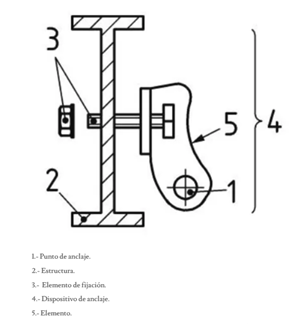
- Type B: Anchor devices with one or more stationary anchor points that do not require structural anchors or anchor elements to be fixed to the structure.
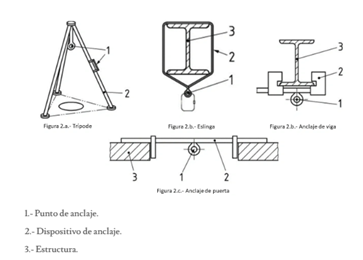
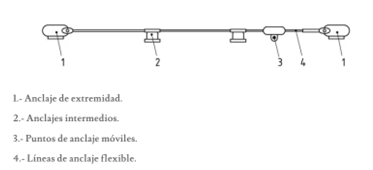
- Type C: Anchor devices equipped with flexible horizontal anchor lines. An anchor device that uses a flexible anchor line that deviates no more than 15° (fifteen degrees) from the horizontal. This is measured by taking the distance between the end and intermediate anchors at any point along the length of the line.
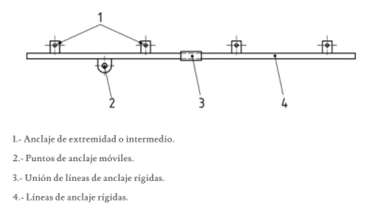
- Type D: Anchor devices equipped with rigid horizontal anchor lines. Anchor devices that use a rigid anchor line that deviates no more than 15° (fifteen degrees) from the horizontal. This is measured by taking the distance between the end and intermediate anchors at any point along the length of the line.
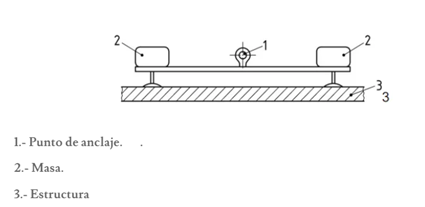
- Type E: Anchor devices for use on horizontal surfaces, whose operation depends solely on mass and the friction between the device and the surface (deadweight anchors).
In upcoming posts we will discuss the requirements and tests for each anchor device. As always, if you have any questions or need advice, you can contact us.