


In recent years, sales of personal protective equipment have soared, something that has been reflected on job sites. Employers and workers are increasingly aware of the importance of using this equipment. What used to be a common sight, for example, a worker on a roof without a safety harness, is no longer so common.
Occupational Health and Safety
But in this article our intention is not to talk about PPE but about collective protection. The fact that PPE use is becoming routine is, as a prevention professional, a source of satisfaction because it means our work is getting through to the worker.
However, we cannot forget that the essence of Law 31/95 of November 8 on Occupational Health and Safety is not to protect the individual but the collective.
Article 15 of the prevention law sets out clearly and precisely the general principles to be followed when applying preventive measures to meet the general duty of prevention toward workers. Specifically, paragraph h) states:
“The employer must adopt measures that give priority to collective protection over individual protection.”
Therefore, the use of PPE is important, but we must remember that its use is subordinate to the impossibility of adopting collective preventive measures. Not using them must be technically justified, and only in that case should we resort to them.

Edge Protection Systems
Within the world of collective protection there is a considerable variety depending on the risks that exist or may arise. These can be edge protection guardrails, lifelines, skylight protection nets, safety nets, etc.
One of the most important and most widely used collective protections, especially on construction sites, is temporary edge protection systems, commonly known as (temporary) guardrails. This collective protection equipment must comply with the UNE-EN 13374:2013 standard. It sets out the minimum requirements they must meet regarding design, characteristics, strength, etc.
Types of Guardrails
The standard classifies the types of guardrails according to the loads the system has to support and the inclination of the working surface.
- Class A: designed and manufactured to withstand static loads only. They hold the weight of a person leaning on the protection or using it for support. In any case, it stops a person falling in the direction of the protection.
- Class B: this type of guardrail withstands only static loads and low-intensity dynamic forces. It must meet the same requirements as Class A. In addition, it must withstand the impact of a person sliding down an inclined surface.
- Class C: withstands high dynamic forces and stops a person sliding down a steeply inclined slope.
Remember that this type of protection cannot carry the CE marking, but it will have a plate specifying the standard it meets. In this case it would be UNE-EN 13374, type of protection (A, B, or C), manufacturer name/identification, year and month of manufacture or serial number, etc.

Permanent Safety Guardrails
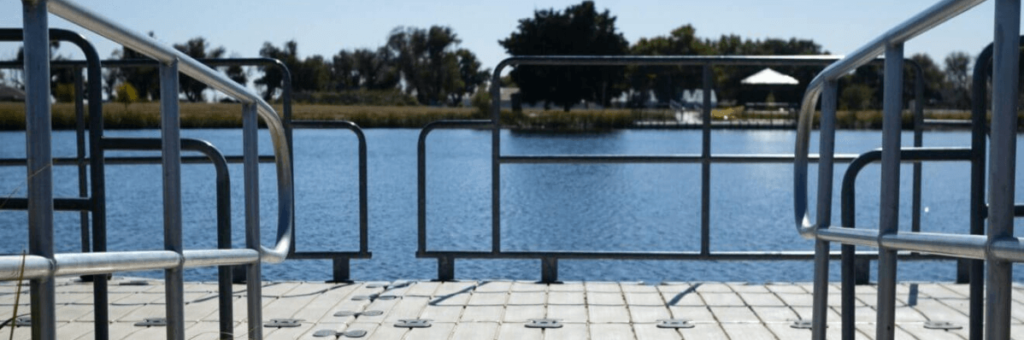
But there is another type of guardrail known as permanent guardrails, which are manufactured and installed under the Spanish standard EN 14122, part 3. Among permanent guardrails there are many types: guardrails with handrails, guardrails anchored to different surfaces (slab, cornice, etc.), straight or curved guardrails, counterweighted guardrails, etc.
As with “temporary edge protection systems”, permanent guardrails cannot carry the CE marking. But they will have a plate specifying the standard they meet, UNE-EN 14122-3, manufacturer name/identification, year and month of manufacture or serial number, etc.

In upcoming articles we will talk about the other collective protections that are being used to effectively protect workers against the risks they are exposed to in their daily work. We will continue with another protection on the rise: skylight protection nets.