


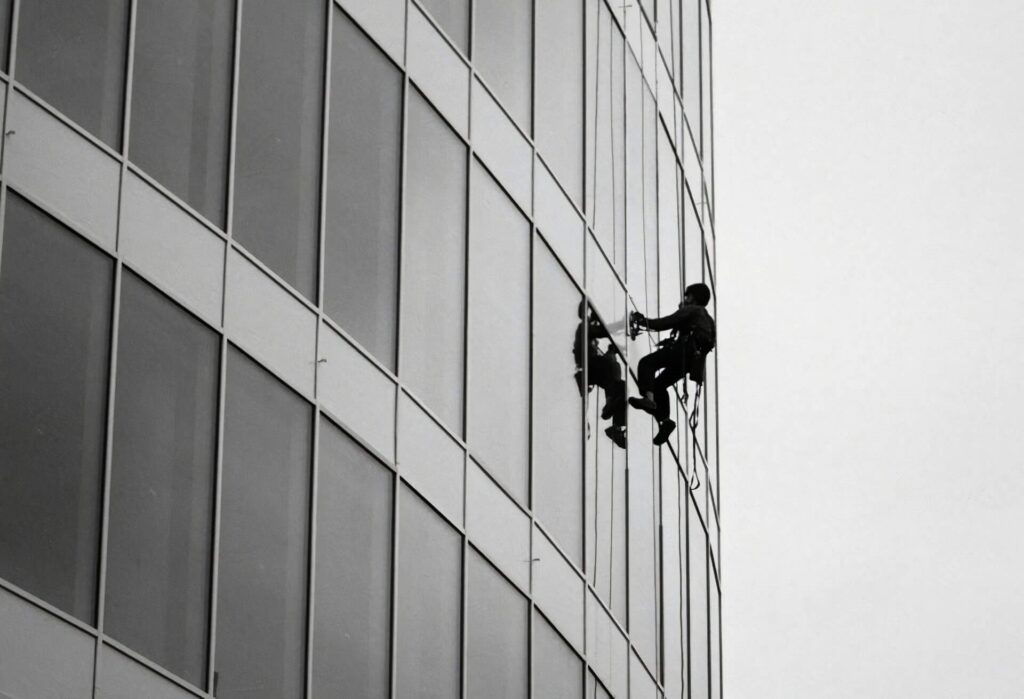
Work at height is one of the work areas where the most accidents occur throughout the year. This can happen in sectors such as construction, industry, telecommunications, or even tasks carried out in private homes, so having collective protection in construction is essential to reduce the risk of falls and ensure workers’ safety in any of these environments.
The 5 Most Common Mistakes in Work at Height
Despite regulations and the wide range of fall arrest systems available, many accidents still happen, partly due to human error, poor practice, or a lack of preventive culture.
Below, we explain some of the most common ones:
Not Using the Right PPE
Personal Protective Equipment is an essential part of work at height, as it protects workers in the event of a fall. Some of this PPE includes: safety harness, helmet with chin strap, and connecting elements such as ropes, lanyards, or self-retracting lifelines,…
However, even though it is indispensable for work at height, one of the most common mistakes is using it incorrectly or not using it when needed.
For example:
- Poorly adjusted safety harness: In the event of a fall, the worker may not be protected because the harness slips off or the worker falls out of it, or, if it is too tight, it may squeeze too much and cause serious injury
- Unsuitable helmet: Although we know a helmet with a chin strap is required for work at height, there are different models, and some of them, for example, are non-conductive of electricity, so when performing tasks of this type we must make sure we choose the appropriate PPE
Misuse of Ladders
Portable ladders are common tools in work at height, but using them incorrectly or setting them up without meeting the manufacturer’s requirements is a mistake, for example:
- Improper placement: Ladders must be placed on a flat, stable surface; some even have their own stabilizers, and placing them on uneven ground can cause them to tip over
- Incorrect angle: A ladder’s stability depends directly on the angle at which it is placed, which should normally be approximately 75º, so an angle that is too steep or too shallow can make the ladder unstable and cause it to fall
Not Using Fall Arrest Systems Correctly
In work at height, having fall arrest systems suited to the task is crucial, because an anchor – whether an anchor point, a lifeline, … whichever it may be – allows the worker to remain secured in the event of a fall.
Some of the mistakes that can be made are:
- Unsuitable fall arrest systems: Depending on the location or environment, one device or another must be installed, and choosing the wrong one can compromise safety
- Poorly installed anchors: Systems that are poorly installed or unsuitable can fail at the most critical moment, that is, in the event of a fall, and therefore not work properly
Not Prioritizing Collective Protection
As the Occupational Health and Safety Law 31/1995 states, collective protection must be prioritized over personal protection. This normally refers to safety guardrails, so one mistake we can make is not having guardrails in areas where we could install them, since they protect all workers and prevent falls.
Lack of Training
The lack of proper training is one of the most critical mistakes in work at height safety. Workers must be trained not only in the use of protective equipment, but also in risk identification, accident response, and safe behavior at height.
Conclusion
Work at height is dangerous in itself, but human error and a lack of preventive measures can make the risks even greater.
The proper use of ladders, fall arrest systems, safety guardrails, and PPE, together with proper training, are key factors in reducing accidents and protecting workers’ lives.
Adopting a strong safety culture, where prevention and ongoing training are priorities, is essential to avoid mistakes as far as possible.