


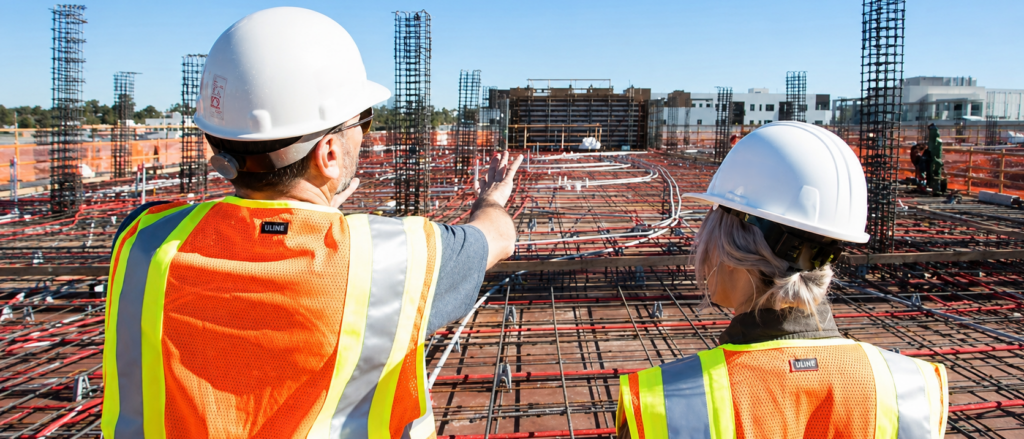
In industrial settings, maintenance, construction, photovoltaic installations, or roof work, few situations create as many organizational and preventive problems as the presence of several companies working simultaneously in the same place.
It is a common situation: a main contractor carries out a construction project, a specialized company installs HVAC systems, another performs electrical work, a third carries out maintenance, and an additional company installs fall protection systems. They all share space, time, and resources, and they also share risks.
This is precisely where one of the most frequent mistakes that continue to be observed in many facilities appears: assuming that having trained workers, with their corresponding PPE or individual documentation, is enough to work safely.
But in reality, it is not.
In work at height, many accidents are not caused by a lack of equipment, but by a lack of coordination between companies, generating operational interference, cross-risks, or situations that were not initially anticipated.
From both a technical and a business management perspective, Coordination of Business Activities (CAE) should not be interpreted solely as a paperwork obligation. It should be understood as a real operational tool for controlling risks, improving productivity, and preventing incidents that can have especially serious consequences.
Experience in manufacturing and installing collective protection systems shows that a technically correct installation can become a dangerous situation if there is no adequate preventive coordination.
What Is Coordination of Business Activities (CAE)?
Coordination of Business Activities (CAE) is the set of measures that companies must adopt when several workers from different trades carry out activities at the same workplace.
The main objective is to ensure that all companies exchange preventive information in order to avoid risks arising from the interaction between simultaneous activities.
Regulatory framework
CAE is mainly regulated by:
- Law 31/1995 on Occupational Risk Prevention: establishes the general principles of prevention.
- Royal Decree 171/2004: specifically develops the regulation of coordination of business activities.
When several companies work at the same workplace, risks cease to be exclusively individual and become shared risks that require coordination.
In work at height, this coordination takes on critical importance because of factors such as:
- Risk of falling to a lower level
- Falling objects from height
- Complex access routes with interference
- Interference between equipment and systems
- Simultaneous work in confined spaces
- Variable weather conditions
- Need for temporary modification of protections
- Multiple anchor points and protection systems
CAE beyond paperwork
A critical point is understanding that CAE does not consist solely of uploading documents to a software platform. Documentation is only one part of the process.
Effective coordination involves:
- Constant communication between companies
- Joint planning of activities
- Clear definition of responsibilities and areas of authority
- Ongoing supervision of compliance
- Dynamic updating of information and procedures
Situations That Require Coordination of Business Activities
Not all situations carry the same level of preventive requirements, but there are scenarios where coordination is mandatory.
Common examples in work at height
- Installation of photovoltaic systems
- Maintenance of industrial roofs
- Coordinated rope access work
- Replacement of roof lights or skylights
- Installation of lifelines
- Installation of permanent safety guardrails
- Simultaneous work in industrial plants
- Maintenance of machinery at height
- Modification of existing protection systems
Risks arising from interaction
When several companies are present at the same time, new risk situations that might not have existed initially appear.
Practical example:
One company installs HVAC ducts on the roof while another performs electrical tasks and a third installs perimeter protection systems. Even if each company correctly manages its own internal risks, risks may arise from:
- Material temporarily stored in walkways
- Tools suspended at height
- Blocked access points or safety routes
- Temporary removal of existing protections
- Movement of heavy machinery
- Crowding of workers in confined spaces
- Incompatibility of protective equipment
Effective coordination requires each type of company to assume its specific responsibilities.
Host employer (owner of the workplace)
The host employer is the one that controls the workplace and has management authority over it.
Main obligations
Inform about existing risks:
- It must communicate, in documented form:
- General risks of the workplace
- Specific risks of the work areas
- Applicable internal rules
- Existing preventive measures
- Emergency procedures
- Characteristics of the facilities
- Example on an industrial roof:
- A roof may present:
- Fragile or non-walkable areas
- Roof lights with limited load-bearing capacity
- Different levels and slopes
- High-voltage electrical equipment
- Fall risks associated with the roof’s shape
- Pre-existing protection systems
All of this information must be passed on in advance and in detail to the concurrent companies.
Establish coordination measures:
It can use different mechanisms:
- Preventive meetings before activities begin
- Designation of specific preventive resources
- Written coordination procedures
- Formal communication systems
- Appointment of a health and safety coordinator, if applicable
Contractor and subcontractor companies
Contractors and subcontractors have equally important preventive responsibilities.
They cannot assume that the entire responsibility for coordination lies solely with the owner of the workplace.
Specific obligations
Inform about the risks generated by their activity:
For example, a company installing safety systems may generate risks associated with:
- Handling heavy loads at height
- Use of electric or pneumatic tools
- Work at the roof edge during the provisional phase
- Temporary work without permanent protection installed
- Welding or cutting operations, if applicable
- Continuous traffic through other companies’ work areas
Ensure worker training:
Workers must have:
- Occupational Health and Safety training appropriate to the risk level
- Specific training in work at height
- Medical fitness certificate issued by a health surveillance service
- Specific preventive information about the workplace
- Qualification for work at height and use of fall arrest systems
- Professional competence certification when required
Ensure that equipment is suitable:
The equipment used must:
- Be compatible with existing protection systems
- Be certified in accordance with current standards
- Be in good condition and properly maintained
- Be suitable for the specific installation environment
- Have complete technical documentation
Documentation Required for Coordination of Business Activities
One of the aspects that raises the most questions is the required preventive documentation. Many companies see CAE solely as an administrative burden.
However, the real objective is to ensure that all participants know the risks and the planned preventive measures.
Company documentation
- Risk assessment that is up to date and adapted to the activity
- Preventive planning specific to the planned activities
- Health and Safety Plan if required by the applicable regulations
- Liability insurance in accordance with legal requirements
- Training certificates for personnel in OHS and work at height
- Designation of preventive resources identifying the person who will act
- Work procedures for specific activities
Worker documentation
- OHS training certification at the required level
- Certification of specific training for work at height (accredited by a competent body)
- Medical fitness certificate issued by a health surveillance service
- PPE delivery record specifying the equipment issued
- Competency certificates for specific equipment (harness, lifelines, etc.)
- Training record on specific protective equipment
Equipment and systems documentation
- Certificates of conformity for equipment (CE)
- Test reports carried out in accordance with standards
- Periodic inspection certificates for protection systems
- Technical manuals in an understandable language
- Documented maintenance sheets
Specific procedures for work at height
Especially critical:
- Rescue and evacuation procedures for emergencies
- Access procedures for work-at-height areas
- Emergency plans integrated with existing systems
- Safe work instructions specific to each activity
- Communication protocol between companies in the event of an incident
Common Mistakes in Managing Coordination
From practical experience, problems such as the following recur systematically:
Confusing documentation with real coordination
Assuming that uploading documentation to a CAE platform is the same as having coordinated properly.
A digital platform does not replace:
- In-person coordination meetings
- Ongoing supervision and follow-up
- Direct communication between companies about changes
- Resolution of emerging operational conflicts
Using generic documentation that is not adapted
Describing activities in an extremely generic way, such as “Work on industrial roof”, for any situation, without specifying concrete characteristics.
Roofs are not the same at every workplace:
- A sandwich panel roof has different characteristics from a deck roof
- A roof with skylights requires specific protections
- A photovoltaic installation creates different risks from conventional maintenance
- Metal versus concrete roofs require different fastening systems
Each environment requires specific, documented technical analysis.
Absence of clearly identified persons in charge
Administrative and operational error:
This is an administrative and operational error, resulting from not explicitly designating:
- Who acts as safety coordinator
- Who is responsible for supervision on each shift
- Who communicates changes to the other companies
- Who reviews incidents and nonconformities
How to Implement Effective Coordination of Business Activities
Implementing effective CAE must go beyond purely administrative paperwork compliance.
A practical, well-founded methodology could be structured as follows:
1. Identification of concurrent activities
Determine exhaustively:
- Which companies will work at the site
- Where they will work in the specific space
- When they will work, with exact scheduling
- What risks each activity generates, with detailed analysis
- How long each phase lasts
2. Analysis of interference between activities
Key technical questions:
- Can one activity negatively affect another?
- Are there shared access routes that could cause conflicts?
- Could simultaneous work take place in confined spaces?
- Is there a risk of objects falling between levels?
- Could safety routes be blocked?
- Will there be interference between personal or collective protection systems?
3. Definition of coordinated preventive measures
Collective protection first:
- Perimeter guardrails sized for simultaneous work environments
- Safety nets in areas with a risk of falling to a lower level
- Access walkways that prevent interference or unexpected falls
- Clear signage of risk areas
- Physical demarcation of work areas
Complementary personal protection:
- PPE suited to the work to be done; not just any PPE will do
- Certified fall arrest systems
- Lifelines with capacity for multiple users where applicable; collective protection is always preferable
- Anchor points in specific locations, suited to the work to be done
4. Assignment of responsibilities and areas of authority
Clear, documented definition:
- Health and Safety Coordinator: identification, training, responsibilities
- Operational managers: by company and shift
- Safety supervisors: clear assignment
- Incident reporting: specific protocol
- Authority to stop work: in case of serious risk
5. Ongoing monitoring and updating
Active management during execution:
CAE does not end when the work begins.
The following must be reviewed and documented:
- Changes to planned activities
- Incidents or abnormal situations detected
- New emerging risks not initially anticipated
- Operational or planning changes: “Job sites are alive”
- Worker feedback on risks detected
- Hold periodic coordination meetings at a set frequency (weekly or daily depending on risk).
The Role of Collective Protection in Coordination of Business Activities
From a technical and operational standpoint, there is one aspect that often goes unnoticed but is strategic for managing CAE:
Collective protection systems considerably simplify preventive management across multiple companies.
Advantages of collective protection in multi-company environments
A roof protected by permanent perimeter guardrails or skylight protection mesh, where skylights exist, makes it possible to:
- Reduce reliance on the human factor to activate protections
- Minimize errors resulting from incorrect use of personal equipment
- Facilitate simultaneous work by multiple companies without equipment conflicts
- Improve work times by eliminating connection/disconnection times
- Reduce the administrative procedures needed for supervision
- Lessen the need for specific training in fall arrest systems
Limitations of exclusively personal solutions
By contrast, solutions based solely on personal fall arrest systems require:
- A greater volume of training
- More continuous supervision
- More exhaustive document control
- A greater number of inspections and reviews
- Greater complexity in coordinating multiple lifelines
- Greater potential for operational errors
For this reason, whenever technically feasible, collective protection should be prioritized in line with the hierarchy of prevention established in Law 31/1995.
Consequences of Non-Compliance with Coordination of Business Activities
Failure to comply with CAE, or poor management of it, can have consequences of several kinds:
Administrative consequences
The competent labor inspection authorities can impose administrative penalties for:
- Absence of documented coordination
- Deficiencies in information exchange
- Failure to follow established procedures
- Failure to designate persons in charge
Penalties can range from corrective orders to significant fines.
Civil consequences
The company may be held civilly liable for:
- Damages caused by a lack of coordination
- Injuries to workers of other companies
- Third-party claims
Criminal consequences
In serious situations, personal liability may arise:
- For the people responsible for coordination
- For technicians who failed to supervise
- If serious or fatal accidents occur
Direct operational consequences
Beyond the strictly legal sphere, there are immediate effects:
- Immediate work stoppage by order of the authorities
- Significant delays in completion deadlines
- Loss of customers who require proof of compliance
- Damage to the company’s reputation
- Considerable increase in execution costs
Conclusion
Coordination of Business Activities in work at height should not be understood as a paperwork obligation imposed by regulations, nor as a simple administrative task tied to digital platforms where the aforementioned documentation has to be uploaded.
In reality, it is a strategic operational tool for:
- Controlling risks arising from the interaction between activities
- Reducing workplace incidents and accidents
- Improving the operational efficiency of any project
- Ensuring regulatory compliance
Operational reality
Experience shows that many serious accidents do not occur because of a lack of protective equipment or the absence of written procedures, but because of poor coordination between companies working simultaneously in the same environment.
Comprehensive strategy
Planning coordination properly, sharing detailed technical information, defining clear responsibilities, and prioritizing collective protection systems makes it possible to:
- Significantly reduce risks
- Improve how the work is carried out
- Increase execution efficiency
- Meet legal obligations
Technically well-studied coordination not only prevents accidents; it also significantly improves the way of working and efficiency.
Frequently Asked Questions
Preventive activities are the set of technical, organizational, and training actions aimed at eliminating or reducing workplace risks before they can cause harm to workers.
Their goal is not only to meet a legal obligation, but to prevent incidents and improve real working conditions.
Responsibility is shared:
Host employer: primary responsibility of the employer
Contractor companies: responsibility to provide information on the risks they generate
Health and Safety Coordinator: if designated, oversight of implementation
Workers: compliance with established procedures