


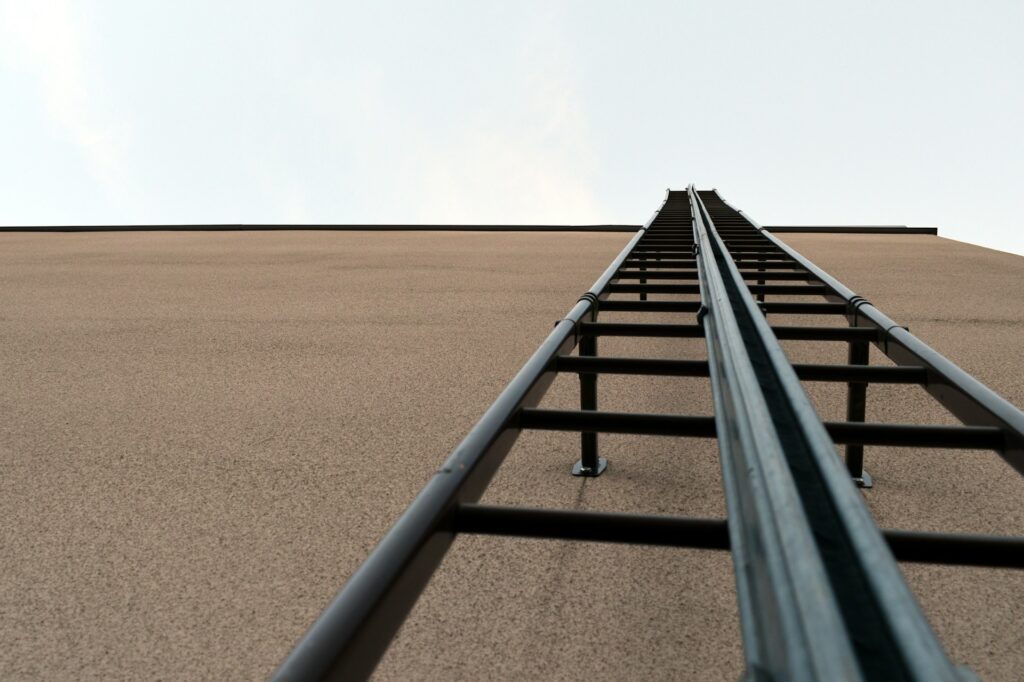
In previous posts we have talked about lifelines in general and, more specifically, about horizontal lifelines. This time, we will take a closer look at another type of these safety systems: vertical lifelines.
What Is a Vertical Lifeline ?
A vertical lifeline is a fall arrest device used as part of a system that ensures the safety of workers who perform tasks at height. In environments such as wind turbine safety, this type of device is essential for vertical work on wind turbines, since technicians must routinely climb up and down very tall towers.
It can be a textile element (such as a rope), a cable, or a rail installed vertically along a structure.
The main purpose of a vertical lifeline is to prevent falls and provide a secure anchor point so workers can secure themselves while performing their tasks at great heights.
To use a vertical lifeline, it must have a trolley or slider that accompanies workers as they move up or down along the lifeline while remaining secured at all times.
Where Can Vertical Lifelines Be Installed?
Vertical lifelines are normally installed on:
- Ladders
- Anchor points
- Temporary systems
- Structural elements
Each of the aforementioned devices requires different considerations, such as using compatible, standards-compliant carabiners, or, if the lifeline is a rope, making sure it has a thimble at one end…
Some of the places where we can find this type of lifeline installed are:
- Construction
- Industry
- Telecommunications
- Adventure parks
- Climbing
- Confined spaces
It is important to note that vertical lifelines must be installed by trained professionals, following the safety regulations and standards in force in each location.
In addition, vertical lifelines must be inspected regularly to make sure they are in proper condition and fulfill their function of keeping workers safe at great heights.
Vertical Lifeline Standards
Vertical lifelines are governed by the mandatory UNE-353 standard.
This standard can be divided into EN-353 1 and EN-353 2. Both are key components in fall protection systems, but they differ in design, use, and characteristics.
Vertical lifelines that follow the EN353-2 standard are those referred to as “rigid anchor lines.” This happens when the lifeline has an anchor at both ends, whether it is a cable or rail line.
In contrast, those that follow EN353-1 are referred to as “flexible” since they only have an anchor at one end, such as a rope.
The choice of one or the other will depend on the specific needs of the workplace and the tasks to be performed.
Each type has its advantages and limitations, and it is important to select the right type of anchor line according to the configuration and conditions of the work at height.