


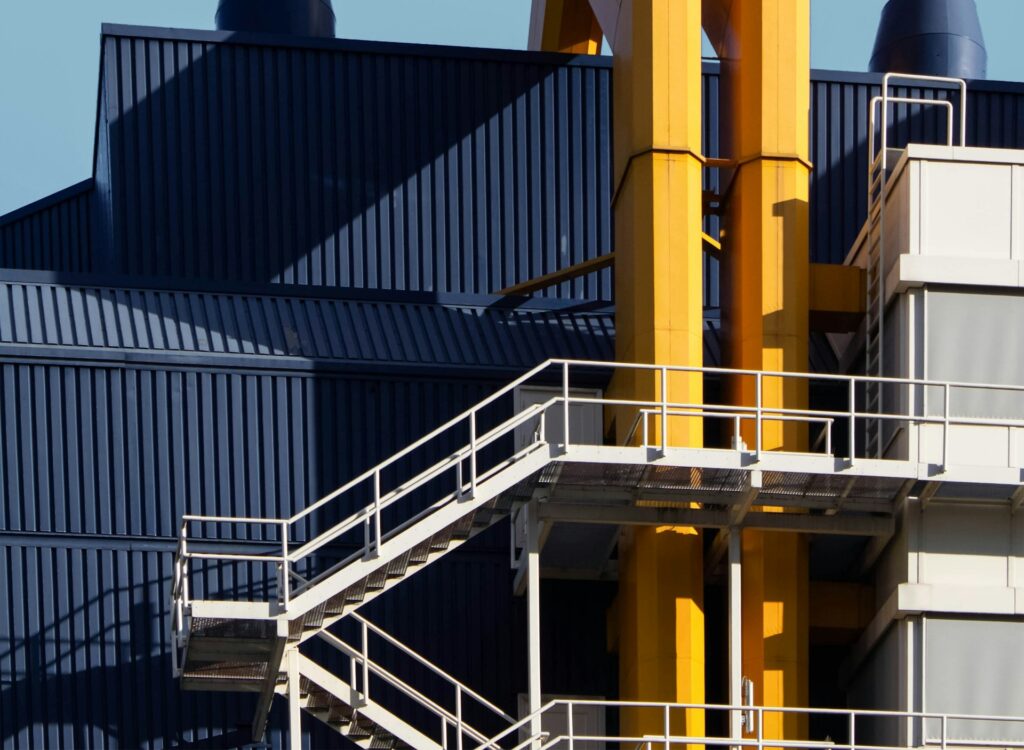
In industry, safely creating access to elevated areas is essential for building an accident-free work environment.
For this, we turn to fixed ladders, but are vertical or inclined ladders better?
Throughout this post, we will look at the differences between the two safety systems to help you choose the most suitable one for each specific situation.
What Factors Influence the Choice of Ladder Type?
To make the right decision when choosing the type of ladder, we need to take several factors into account, including the following:
- Height to be bridged.
- Frequency of use.
- Worker comfort, depending on the work to be done.
Depending on these factors and the type of access, the UNE EN ISO 14122 standard will set the specific requirements that ensure these elements are safe, comfortable, and functional.
Which Type of Ladder Should You Choose?
Let us look at the two types of ladders we may encounter: vertical ladders and inclined ladders.
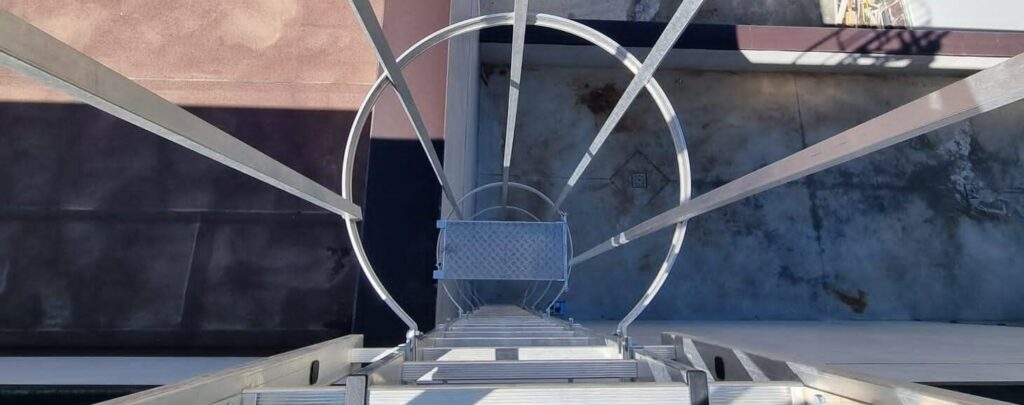
Fixed vertical ladders
Vertical ladders are fixed structures that allow access to elevated areas such as silos, industrial roofs, and structures where space is more limited and does not allow the installation of inclined ladders.
The main advantages of this type of ladder are:
- Reduced space occupied.
- Ability to bridge great heights.
- Robust and stable structure.
Even so, there are also some disadvantages to these safety systems because, due to their construction, they require more physical effort from the operator, especially at great heights, which entails a greater risk of falling.
Another disadvantage of this type of construction is the difficulty of carrying maintenance tools or materials up them.
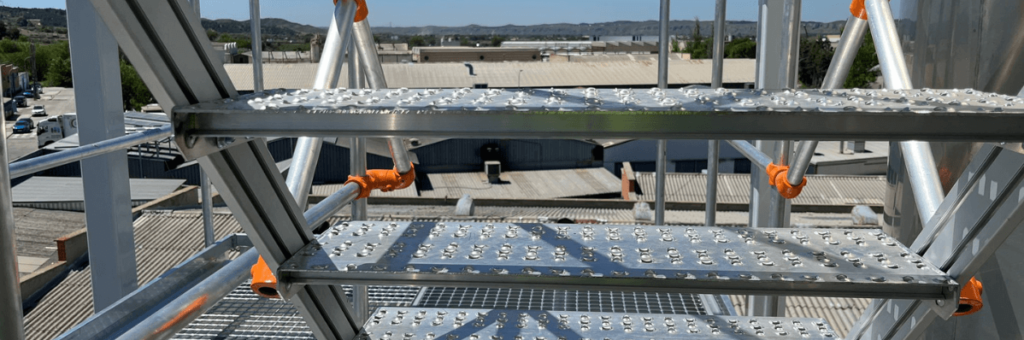
Inclined Ladders
Inclined ladders, for their part, usually have a slope of between 45° and 60°, which allows us to create access that is safe and also more comfortable for operators.
It is common to find this type of ladder in:
- Maintenance platforms.
- Access to machines.
- Access to elevated areas with frequent traffic.
Because they are safer, these systems require fewer protective elements than vertical ladders, since vertical ladders, depending on their height, may require:
- Safety cages or surrounding protective hoops.
- Rest platforms.
- Inclusion of vertical lifeline systems.
However, inclined ladders involve fewer technical requirements but can mean a greater financial investment, as they are bulkier and have a larger number of components, such as:
- Guardrails, if the height of the ladder exceeds 500 mm.
- Protective toe boards on the sides.
For these reasons, each type of ladder has its applications depending on the height and the frequency of use we intend for it.
When to Choose a Vertical Ladder and When an Inclined One?
For example, if we had to create access to the roof of a 12 m industrial building, the most advisable option would be a vertical ladder, with the appropriate intermediate platforms and the corresponding lifeline to reinforce safety.
This system would avoid taking up too much space on the facade and would reduce the project cost by using less material, while guaranteeing safe access for workers.
Conclusion
The choice between a vertical ladder and an inclined ladder will depend on:
- Available space.
- Frequency of use.
- Required safety.
Vertical ladders are perfect systems for great heights in confined spaces, while inclined ladders are more comfortable and safer for creating access with more frequent use, but they require more space for installation.
To make the right decision, the corresponding risk assessment must be carried out first, and then the system that best fits our needs should be selected.
That is why we always turn to personnel qualified in industrial access systems, who will guide us in choosing the system that best fits the needs of each environment.