



Ensuring worker protection in different work environments requires compliance with a series of European and national regulations that ensure the effectiveness of the equipment used.
Among these regulations, CE marking on Personal Protective Equipment (PPE) is one of the most important certifications, since it shows that the product meets the safety and health requirements established in the European Union.
What Is CE Marking and What Does It Mean for PPE?
CE marking, from the French Conformité Européenne, is a mandatory mark for many products, including PPE. It indicates that the manufacturer has assessed the product and certified its conformity with all applicable EU legislation.

In the case of PPE, it guarantees that the equipment has undergone technical testing, risk analysis, and assessment procedures appropriate to its level of protection.
For the end user, CE marking means that the PPE meets minimum standards of safety, reliability, and effectiveness under the intended conditions of use.
What Are the CE Marking Regulations?
The main regulation governing CE marking on PPE is Regulation (EU) 2016/425, on personal protective equipment. This regulation, adopted on March 9, 2016, entered into force on April 21, 2018, and replaced earlier directives, such as:
- Directive 89/656/EEC, on the minimum health and safety requirements for the use by workers of PPE at the workplace,
- Royal Decree 773/1997, on minimum health and safety provisions regarding the use by workers of PPE.
- Other specific rules on product marketing and control, such as Royal Decree 1591/2009 for medical devices that may overlap with personal protection.
- And other supplementary regulations that govern specific aspects of marking and conformity assessment.
In addition, in Spain compliance with this regulation is implemented through Royal Decree 842/2006, which establishes the conditions for the marketing and use of PPE in the workplace.
How Is PPE Classified and Assessed?
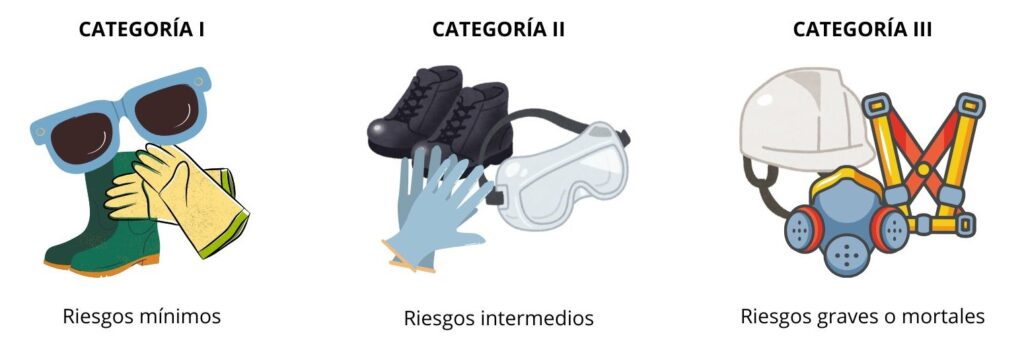
Under Regulation (EU) 2016/425, PPE is classified into three categories, according to the level of risk it protects against:
Category I – Minimal risks
Examples: sunglasses, gardening gloves.
- Assessment: Self-certification by the manufacturer through internal production control.
Category II – Intermediate risks
Examples: mechanical protection gloves, safety glasses, safety footwear.
- Assessment: EU type-examination carried out by a notified body.
Category III – Serious or fatal risks
Examples: fall arrest harnesses, respiratory protective equipment, protection against chemical or biological products.
- Assessment: EU type-examination + quality control of the final product (module C2) or production quality system control (module D), both under the supervision of a notified body.
What Are the Requirements for CE Marking on PPE?
For PPE to bear the CE marking, it must meet several requirements set out in Regulation (EU) 2016/425:
- Conformity assessment: The process varies according to the PPE category (classes I, II, or III). Category III products, such as fall protection harnesses or impact-resistant helmets, require assessment by a notified body; in category I, the assessment may be done by the manufacturer itself.
- Technical documentation: The manufacturer must prepare a technical file that includes all information on design, manufacturing, tests performed, risk assessment, and intended use.
- Declaration of conformity: A document in which the manufacturer certifies that the PPE meets all applicable requirements of the regulation and that it has followed the appropriate assessment procedures.
- Marking on the product: The CE marking symbol must be placed on the equipment itself (whenever possible), as well as on the technical documentation and the packaging. The regulation specifies the size, durability, and visibility requirements for this marking, as well as the inclusion of the notified body’s identification number where applicable (especially on category III equipment).
Why Is CE Marking Important in Work at Height?
CE marking acts as an essential tool to ensure that the PPE used in workplaces offers effective protection and meets legal requirements. This protects both employers and workers, reducing workplace incidents and promoting a culture of prevention and safety.
For example, in the case of a safety harness for work at height, prior assessment and CE marking ensure that the product has been tested to withstand loads, has been designed in accordance with the standards, and that the user can trust its ability to protect in the event of a fall.
What Are the Legal Obligations?
For PPE manufacturers, these obligations include:
- Designing, manufacturing, and verifying the PPE in accordance with the Regulation.
- Preparing the EU declaration of conformity and keeping it for 10 years.
- Affixing the CE marking and notified body number (if applicable).
- Drawing up and maintaining the technical documentation.
- Ensuring the traceability of the product.
- Including user manuals and warnings.
PPE importers must:
- Make sure the manufacturer has fulfilled all of its obligations.
- Not place non-compliant products on the market.
- Indicate their name, registered business name, and address on the product or packaging.
- Keep traceability documentation.
- Cooperate with authorities in inspections or corrective measures.
In distribution, companies must make sure to:
- Verify that the PPE bears the CE marking and comes with manuals in the official language.
- Ensure that the product is not damaged or altered.
- Withdraw non-compliant products from the market if irregularities are detected.
- Ensure proper storage and transport.
Changes and Additional Requirements Introduced by Regulation (EU) 2016/425
Since it entered into force, the Regulation has introduced several new features, including:
- The obligation to include in the CE marking the identification number of the notified body that carried out the assessment, on category III equipment.
- The obligation to include the date of manufacture (month and year) on the product label or in the technical data sheet for products subject to aging, such as textile helmets or equipment protecting against biological agents.
- Greater emphasis on product traceability, requiring the manufacturer to keep records that make it possible to identify each batch or series.
How Can You Verify That CE-Marked PPE Is Compliant?

Check the CE marking on the product
- It must be visible on the equipment or its packaging.
- For category III, it must be accompanied by the notified body number (for example, CE 0120).
- The marking must not be easily removable or a simple sticker.
Review the documentation
- User manual in Spanish.
- Information on maintenance, warnings, and intended use.
- Technical data sheet with harmonized standards (e.g., EN 388, EN 166).
- EU declaration of conformity (physical or digital).
Verify the notified body
- Access the official European NANDO database.
- Enter the 4-digit number (e.g., 0086) and check that it is authorized to assess that type of PPE.
Make sure of traceability
- The product must include a batch number, date of manufacture, and contact details of the manufacturer or importer.
- Be wary of products with no clear brand, no documentation, or purchased from unregulated platforms.
Conclusion
CE marking on PPE is not just a formality, but a solid guarantee that the equipment meets the standards needed to provide effective and safe protection in the workplace, in compliance with European legislation (Regulation (EU) 2016/425) and Spanish legislation (Royal Decree 842/2006).
This certification system gives both manufacturers and users a clear reference on the quality and reliability of the equipment, fostering a safer work environment in line with international legal requirements. For employers, it is essential to verify that all PPE bears this marking before it is purchased and used at the workplace.
We hope this article gives you a general idea of what CE marking is and what implications it has for both workers and the general public. If you need more information, don’t hesitate to contact us