


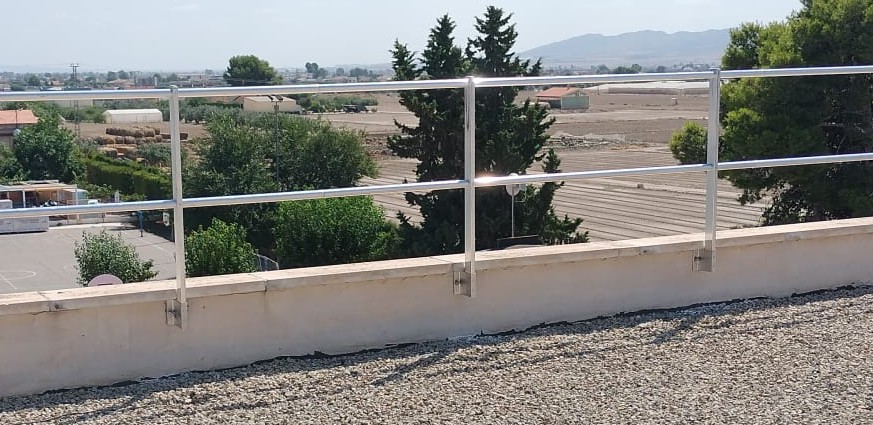
A safety guardrail is a collective protection system installed in elevated areas, designed to prevent falls to a lower level. It usually consists of a handrail, vertical posts, and a toe board, thus providing protection against possible falls.
Why Are Safety Guardrails Inspected?
Inspection is important because it prevents falls, one of the most serious risks in work at height. Guardrails can be exposed to various environmental factors, wear, and impacts that can weaken them.
A good inspection identifies problems in time, ensuring that the guardrail continues to protect those who work and move around in elevated areas such as roofs, terraces, or platforms.
When Should a Guardrail Be Inspected?
Once the guardrail is installed, inspections must be carried out at different points throughout its service life. These inspections are necessary and make it possible to verify that the system works and maintains adequate safety conditions.
After Guardrail Installation
The entire guardrail must be inspected for the first time.
In this first inspection we check that the installation follows the manufacturer’s instructions and recommendations. All of its parts must be perfectly assembled, as indicated in the assembly manual.
This first visual check ensures that the guardrail meets the safety requirements from day one.
Periodic Inspections
In addition to the initial inspection, guardrails must undergo regular periodic inspections. The frequency of these inspections may vary depending on the environment, whether it is exposed to rust, or the environmental conditions of the site.
The most common practice is to carry out an inspection at least once a year, but sometimes, in industrial or chemical facilities or in areas with harsh conditions, it is advisable to increase the frequency of inspections.
After an Accident or Modification
It is essential to inspect the guardrail whenever any modification has been made to the roof, if parts of the system have been replaced, or when it is suspected that it has taken an impact.
A blow from a machine, a tool, or transported materials can affect the stability of the system, so it is important to verify its condition before continuing to use it for protection.
Steps for Inspecting a Safety Guardrail
A complete inspection must follow a series of steps that allow all the components of the protection system to be checked:
1. General Visual Inspection
The first step is to carry out a visual inspection of the entire guardrail. At this stage we check that the system is complete and that no elements such as intermediate rails, handrails, or toe boards are missing.
We also look for dents, visible deformations, or loose parts that could affect its operation.
2. Checking the Fasteners
When checking the fasteners, we verify that the guardrail’s anchors, screws, and brackets are in good condition and show no wear, and that they are the ones specified by the manufacturer.
It is crucial to make sure there are no loose or damaged elements, since the fasteners ensure the safety and stability of the system.
3. Inspection of the Protective Elements
In this step we inspect the components that make up the guardrail, such as the handrail, vertical and horizontal posts, intermediate rails, or toe board. These parts must be correctly installed and maintain the proper height and spacing, as indicated by the manufacturer.
We will also verify that there are no bent, broken, or incorrectly positioned parts that could reduce the effectiveness of the collective safety system.
4. Assessment of Corrosion or Wear
In outdoor installations, signs of wear or corrosion commonly appear over time. During the inspection, the metal surfaces are checked for rust, deterioration, or loss of material.
If corrosion affects the structural strength of the system, we will have to repair or replace the affected or damaged parts.
5. Stability Check
Finally, the stability of the guardrail must be verified. This involves checking the structure it is installed on; it must not and cannot show excessive movement, and it must be firm and well anchored.
If the guardrail moves or has play, it may not withstand a load in the event of a fall, which is a very important point.
What Standards Apply to Inspections?
The regulations set requirements for height, strength, and the components of the system, such as handrails, toe boards, and profiles. This ensures that guardrails meet a minimum level of protection for safety at height.
Who Should Carry Out the Inspection?
The inspection must be carried out by competent personnel such as, for example, OHS technicians, maintenance managers, or work-at-height safety companies. It is essential that those carrying out the inspection have training and experience in collective protection systems.
What to Do If a Guardrail Fails Inspection
If the inspection detects defects that compromise safety, the guardrail must not be used until the problem has been resolved. Depending on the type of damage, it may be necessary to adjust the fasteners or to repair or replace parts of the system.
In some severe cases, it may be necessary to replace the entire guardrail. The incident must also be recorded and action taken as part of a maintenance plan.
Conclusion
Safety guardrails are essential collective protection on roofs and elevated areas; carrying out routine inspections ensures that the system maintains its safety and protection.
Proper maintenance is the foundation for protecting people and preventing accidents.