


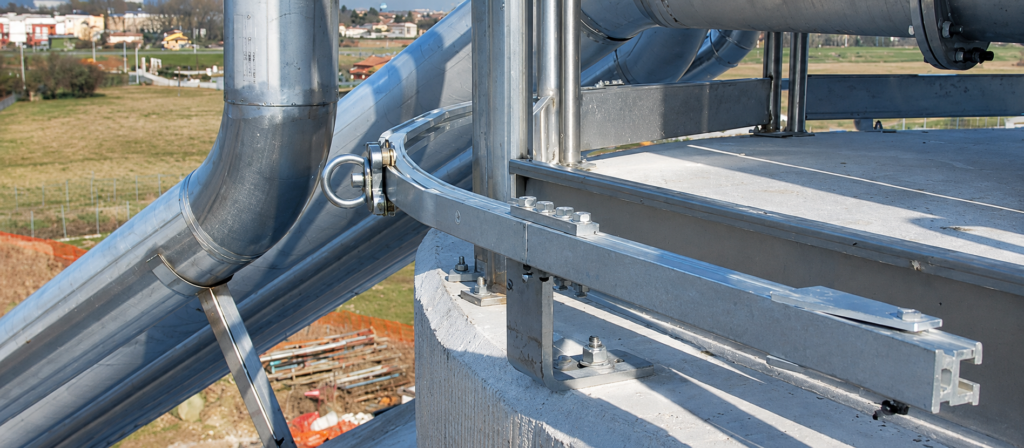
Lifelines for work at height are among the most widely used fall protection systems on industrial roofs, photovoltaic installations, vertical ladders, structures, and maintenance areas. However, considerable confusion persists around them: which regulations they must meet, in which cases they are mandatory, who can use them, and what documentation must exist after installation.
To begin with, we must be clear that in Spain there is no single “lifeline standard” that determines how any work at height must be handled.
The legislation establishes the obligation to assess the risk of falling and to adopt appropriate preventive measures, giving priority, whenever technically feasible, to collective protection over personal protection. From there, it is the technical standards that set the requirements applicable to each type of equipment and device.
Moreover, not all lifelines are technically governed by the same framework. A horizontal line, a vertical line, and a permanent anchor device are distinct solutions and must be treated as such.
A rigorous knowledge of lifeline regulations is a requirement for designing, installing, and maintaining systems that provide effective protection for the worker.
What Lifeline Regulations Are and Who They Apply To
When analyzing lifelines and Spanish regulations, we must distinguish between preventive legislation and technical standards.
The legislation sets out the obligations of employers and workers. Law 31/1995 on Occupational Health and Safety sets out the general principles of preventive action: avoiding risks, assessing those that cannot be avoided, combating them at the source, and giving priority to collective protection measures over personal protection.
For its part, Royal Decree 2177/2004 establishes the minimum provisions for the use of work equipment and includes specific provisions for temporary work at height. Its approach is especially relevant: when a job cannot be performed safely from a suitable surface, equipment must be selected that ensures safe working conditions.
This means that installing a lifeline should not be the automatic response to any fall risk. The following must be analyzed beforehand:
- Whether the risk can be eliminated.
- Feasibility of collective protection measures.
- Characteristics of the work to be performed.
- Frequency of access.
- Potential fall distance.
- Connection system required.
- Structure on which the device will be installed.
- Possibility of rescue.
When, after this assessment, it is concluded that a personal fall protection system is necessary, the lifeline may be part of the solution.
The obligation falls primarily on the employer, who is responsible for ensuring safe working conditions, but designers, prevention services, manufacturers, installers, maintenance providers, and, finally, the users themselves are also involved throughout the system’s life cycle.
What the UNE-EN 795 Standard Establishes by System Type
The UNE-EN 795:2012 standard on anchor devices is one of the most frequently cited references on lifelines. Its application must, however, stay within its scope.
This standard covers anchor devices intended for a single user and establishes the following types:
- Type A: anchor devices with one or more fixed anchor points, which require structural anchors or fasteners.
- Type B: temporary anchor devices or provisional anchor devices.
- Type C: devices with a horizontal flexible “cable” anchor line.
- Type D: devices with a horizontal rigid “rail” anchor line.
- Type E: deadweight anchor devices, for use on horizontal surfaces.
When the system is intended for simultaneous use by several people, the technical specification CEN/TS 16415:2013, for multi-user anchor devices, must be considered.
Likewise, UNE-EN 17235, published in 2025, which covers permanent anchor devices and safety hooks, is becoming relevant.
Here we want to point out the differences between the UNE-EN 795 standard and the new UNE-EN 17235 standard. UNE-EN 795:2012 applies to removable anchor devices intended for one user, whereas anchor systems permanently installed on buildings and structures must now be assessed under UNE-EN 17235:2025.
Consequently, UNE-EN 795 cannot be used as a universal answer for any anchor system installed on a roof. It is essential to identify precisely the product, how it is installed, and its intended use.
Vertical Lifeline Regulations
Vertical lifelines are governed by a different technical framework. Systems intended for vertical movement using a guided type fall arrester fall mainly under the UNE EN 353 standard on guided type fall arresters, in its two parts:
- UNE-EN 353-1: guided type fall arresters on a rigid anchor line.
- UNE-EN 353-2: guided type fall arresters on a flexible anchor line.
These systems are common in:
- Vertical ladders.
- Towers.
- Industrial installations.
- Wind turbines.
- Silos.
- Metal structures.
The anchor line and the compatible fall arrest device are part of the certified assembly. It should not be assumed, therefore, that any trolley or sliding device can be used on any cable or rail. The fact that a component can be physically inserted into or moved along the line does not prove that the combination is valid. The user must use only the device specified by the manufacturer for that system.
This point requires special verification in older installations, where trolleys, manuals, or original documentation may have been lost over the years.
Standards for Horizontal and Temporary Lifelines
Several technical solutions coexist among horizontal lifelines. Flexible anchor devices for horizontal use 795C, that is, flexible horizontal lifelines, are identified in UNE-EN 795 as type C, and rigid horizontal lifelines as type D. Their purpose is to let the worker move while keeping a continuous connection point in an area with a fall hazard.
They are commonly used in:
- Industrial roofs.
- Photovoltaic plants.
- Logistics buildings.
- Commercial buildings.
- Maintenance facilities.
- Platforms and structures.
There are also temporary or portable systems that are installed only while certain work is carried out and removed afterward. Depending on their design and configuration, they may correspond to different solutions covered by the applicable standards, so the manufacturer’s specific documentation must always be checked.
A common mistake is to assume that a temporary line requires a lower level of control because it is used for a short period. The system must be installed on elements capable of withstanding the expected loads and in compliance with the conditions defined by the manufacturer.
For any horizontal line, analyzing the fall clearance is also decisive. During a fall, especially with flexible systems, several travel distances and deformations come into play: the length of the connecting system, the activation of the energy absorber, the displacement of the user, and the deformation of the line itself.
A properly certified lifeline can be ineffective if there is not enough space below the worker to stop the fall before reaching a lower level or another obstacle. For this reason, selecting a lifeline cannot be based solely on whether it “meets the standard”; it must be suitable for the specific installation.
How to Verify That Your Lifeline Meets the Standards
A lifeline that has been installed on a roof for years cannot be considered safe simply because it looks good. Verification must begin with identifying the system.
1. Identify the manufacturer and model
It must be possible to determine which system is installed and who made it. Without this information, it is not possible to know:
- Its usage limitations.
- Maximum number of users.
- Compatible devices.
- Permitted configurations.
- Inspection procedure.
2. Check the applicable standard
It is not enough to require that the system “comply with UNE-EN 795.” You must first determine which system is being analyzed, since a vertical line, a temporary horizontal line, or a permanent anchor system do not necessarily fall under the same standard.
3. Review the installation and the supporting structure
A lifeline does not work in isolation. In the event of a fall, the loads are ultimately transmitted to the structure. The following must therefore be checked:
- Supports.
- Fasteners.
- Intermediate elements.
- Condition of the structural support.
- Actual configuration compared with the intended design.
The apparent good condition of the cable does not guarantee the safety of the installation as a whole.
4. Verify the maximum number of users
Not all lines allow several workers to use them at the same time. The system documentation must state the maximum number authorized, which must never be increased by estimation or simply because there is physical space to connect more people.
5. Check the PPE and compatible components
The harness, the connecting element, the energy absorber, the self-retracting device, or the sliding trolley must be selected as part of a complete system. Compatibility between components is essential, and on vertical lines, the fall arrest device designed for the corresponding line must be used.
6. Check inspection and maintenance
Fall protection systems must be maintained in accordance with the manufacturer’s instructions. At the installation, it should be possible to find out, at a minimum:
- Installation date.
- System identification.
- Installing company.
- Date of the last inspection.
- Maximum number of users.
- Compatible equipment.
- Usage limitations.
Any subsequent modifications to the roof or the structure must also be assessed. Adding new photovoltaic panels, HVAC equipment, ducts, or other structures can alter the travel paths and the original conditions for which the lifeline was designed.
7. Don’t forget the rescue procedure
Arresting the fall is only part of the problem. If a worker is left suspended after a fall, there must be a plan of action that allows a quick and safe rescue.
For this reason, the design of a fall arrest system must consider not only how to prevent or arrest the fall, but also what happens immediately afterward.
In work-at-height safety, standards are essential, but meeting a technical reference does not replace a proper risk assessment.
A safe lifeline is one that has been properly selected, installed, documented, inspected, and used within the conditions for which it was designed.
Frequently Asked Questions About Lifeline Standards
It depends on the system. Horizontal lines and anchor devices may be subject to UNE-EN 795:2012, to CEN/TS 16415:2013 in the case of certain multi-user systems, and to UNE-EN 17235 for permanent devices. Vertical lines are governed mainly by UNE-EN 353-1 and UNE-EN 353-2.
There is no general obligation to install a lifeline for every job at height. The risk assessment must determine the necessary solution, and the law requires giving priority, where technically feasible, to collective protection over personal protection. A lifeline will be one of the possible solutions when it is appropriate for controlling the risk.
Flexible horizontal anchor lines are covered as type C and rigid ones as type D in UNE-EN 795:2012, within its scope of application. For multi-user systems, CEN/TS 16415:2013 must be considered, and for permanent anchor systems, UNE-EN 17235, which has been in force since 2025, must also be analyzed.