



This week we will talk about the different types of fixed vertical ladders available on the market.
To begin with, these safety systems are mainly used for access to machines, access to maintenance areas, roofs, wells, silos, scaffold towers, restricted access areas, level differences between roofs, and high-voltage towers, among other uses.
Because of their functional versatility, we find different models and materials of these types of ladders.
That is why the UNE-EN ISO 14122-4: Fixed ladders standard addresses the different materials and construction aspects for each of the models to be installed in the various situations we may encounter.
What Types of Fixed Vertical Ladders Are There?
We will begin by talking about the most common system in the work-at-height safety sector: two-rail fixed vertical ladders.
Two-Rail Vertical Ladders
Most commonly known as fixed ladders with safety cages.
They consist of a left rail and a right rail with rungs set between the two rails, and they make up the most common type of fixed vertical ladder structure.
They are made mainly of aluminum. Its light weight and strength mean that these ladders meet the ergonomic requirements, both for handling during installation and for later use, set by the aforementioned standard UNE-EN ISO 14122-4.
We can say that this type of fixed vertical ladder is the standard model of these safety systems.
These units can include landing extensions to make it easier for users to step off, either frontal or side exits. Their location will be determined by the obstacles to be bridged and the area where the installation will take place, as well as the area to be reached from the landing itself.
Another feature they include is surrounding protection. This protective hoop is required when fixed vertical access ladders exceed 2.20m in height.
We can also find other elements such as rest platforms or folding rungs, which must be installed when this type of system exceeds 10m in height, and are recommended from 6m.
Another specific aspect of this type of ladder is that it can be fastened to any type of surface, which makes it a very common safety system in installations.
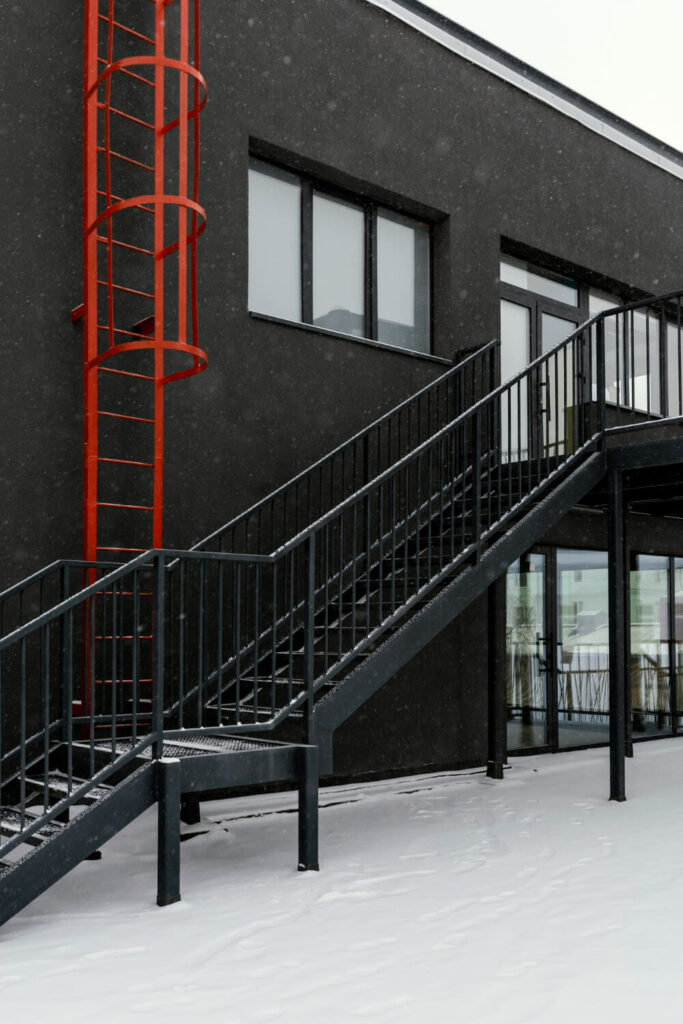
Single-Rail Vertical Ladders
Also known as a fishbone ladder; as its name suggests, it consists of a single central rail to which the rungs are attached on both sides.
This type of ladder is commonly found on high-voltage towers, monopoles, and very narrow places where two-rail ladders cannot be installed.
All the design and manufacturing information for these ladders can be found in the aforementioned standard; it covers all the technical aspects regarding rung dimensions, spacing between them, and other guidelines to be taken into account to provide the necessary safety on this type of ladder.
A very common practical case where the question of how to climb a wind turbine safely arises is precisely the maintenance of wind turbines. In these structures, single-rail fixed vertical ladders built into the tower shaft are the most common system, combined with a vertical lifeline that allows climbing and descending in complete safety.
Manhole Step Ladders
A variety of this model is the ladders typically found at access points to wells, manholes, silos, and similar locations: manhole step ladders. These also comply with the standard UNE-EN-13101:2003 Steps for underground man entry chambers.
Made of polypropylene, they make these ladders the ideal material for installation in these hard-to-reach areas, providing all the necessary safety, both ergonomically, to ease access, and through their slip resistance.
But it should be noted that this is not just an ordinary single-rail fixed vertical ladder. In some cases it is made up of individual loose manhole steps that we can anchor in different ways depending on the type of structure where they need to be fastened.
Sometimes they have to be fastened with anchoring elements, and other times they are built directly into the structure, as in the case of access to wells, where these elements are embedded directly in the concrete structure that lines the well itself.
In their single-rail version, we note that the rail has a fall arrest system already built in, so they would not need the surrounding protection mentioned for two-rail vertical ladders.
As we can see, the choice of one type of ladder or another will depend on the place where the installation is to be carried out, the type of installation itself, and the possible risks we may find due to the environment where they are installed.
Fixed Vertical Ladder Materials
Although we have already mentioned some of the materials used in manufacturing these safety systems, it is important to note that, given the hazards of the areas where we carry out installations, we also have the following materials:
Fiberglass or FRP Ladders
In this case, they would be used in place of aluminum or manhole steps when, besides being in wells, manholes, etc., the type of installation involves electrical risk, since this material is a good insulator thanks to its dielectric capacity.
Stainless Steel Ladders
This type of construction would be used in abrasive environments. Depending on the abrasion level of the environment, we would need to use different grades of stainless steel, such as AISI 304 or 316.
As we can see, there are many factors to take into account when choosing the right safety systems and the type of materials. Therefore, it is advisable to follow the criteria of the various manufacturers of fixed vertical access ladders.