


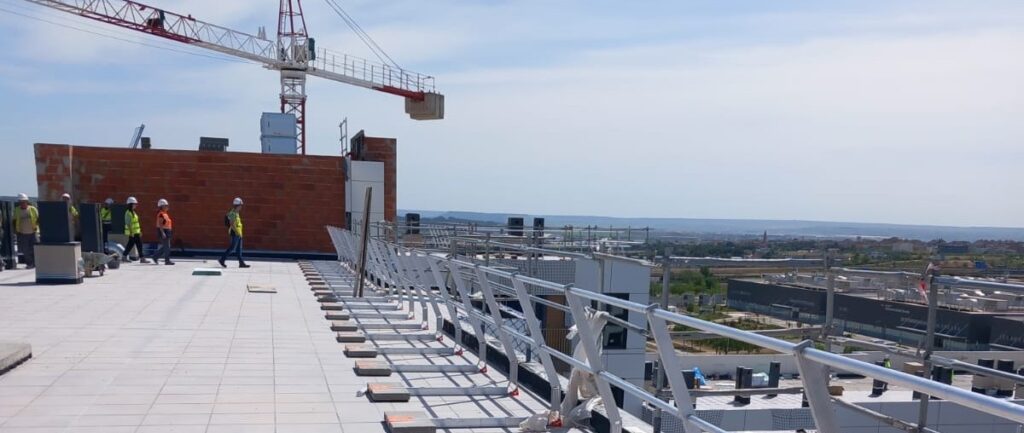
In industrial workplaces, fragile roofs, or roof maintenance work, productivity is one of the main performance indicators. Reducing execution times, minimizing downtime, and optimizing resources are common goals on any project. However, a frequent mistake persists that continues to cause incidents and cost overruns at many companies: believing that increasing work speed means cutting back on safety measures.
In reality, exactly the opposite is true.
A well-planned, well-designed preventive strategy not only protects the workers who are exposed day after day to work considered high-risk, but also improves organization, minimizes errors, avoids unnecessary stoppages, and increases efficiency. In work at height, where risks can have especially serious consequences, safety must be built in from the project’s preventive planning stage, not treated as something that causes delays in the production process.
From our experience in manufacturing and installing protection systems for work at height, it is clear that productivity and safety are not opposing concepts, but two directly related factors when the right technical solutions are applied.
The Mistake of Putting Speed Ahead of Safety
One of the most common problems in the fall protection industry is treating safety as an unnecessary cost and a waste of time. This mistaken view tends to lead to wrong decisions such as:
- Eliminating preventive measures to “save costs” and “gain time”
- Misuse and, in some cases, lack of PPE
- Improvised roof access
- Work without preventive planning
- Absence of adequate protection systems, whether personal or collective
In the short term it may seem like a way to speed up production, but in practice it ends up causing:
- More incidents and errors
- Constant interruptions to the work
- The need to redo unfinished work
- Serious workplace accidents, in most cases fatal
- Significant increase in indirect costs
How Accidents Affect Performance
A workplace accident not only has serious human consequences. It also has a strong operational and financial impact on the company.
Partial or total shutdown of activity
After a serious accident, companies often have to temporarily halt work in order to carry out:
- Incident investigations
- Labor inspections
- Immediate corrective actions
- Inspections of protection systems, where they exist
Loss of productivity
Reorganizing teams, replacing personnel, or planning delays directly affect:
- Delivery deadlines for the work, which become compromised
- Coordination with the other trades involved on site
- The efficiency of the rest of the team
- Meeting the set objectives
Increase in direct and indirect costs
Accidents generate multiple costs:
- Medical care and hospitalization
- Administrative penalties
- Higher insurance premiums
- Repairs to equipment and facilities
- Loss of materials
- Unproductive hours
- Legal and administrative costs
- Compensation payments
- Loss of a customer due to lack of professionalism
Damage to professional image
More and more industrial customers demand high standards of occupational risk prevention, specialized training for the work to be done, specific training that requires authorization from manufacturers, and rigorous documentation control in matters of safety: the well-known coordination of business activities (CAE).
Productivity Is Built Before You Go Up on the Roof
One of the fundamental concepts in work at height, and one that is sometimes forgotten, is understanding that real productivity is built during the project planning phase.
A technically well-organized job reduces unnecessary stoppages, avoids improvisation, improves coordination, and increases the overall safety of the work environment.
Constant improvisation creates accumulated inefficiencies that end up compromising completion deadlines.
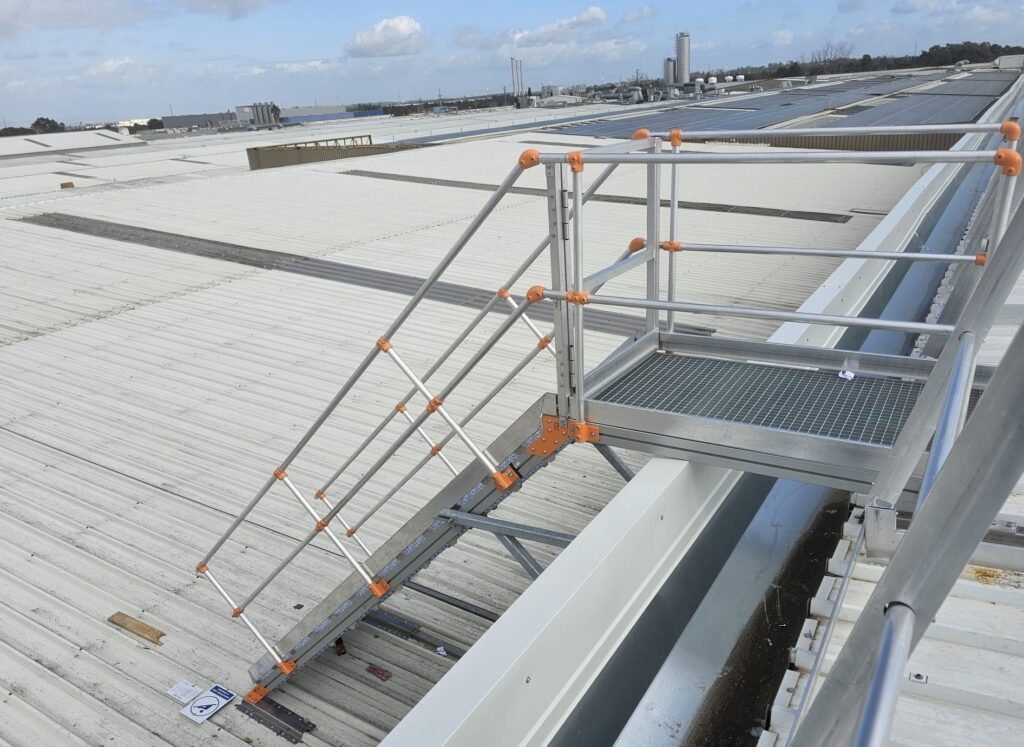
Keys to Increasing Productivity in Work at Height
Efficient planning and risk assessment
Before starting any job, critical factors must be analyzed, such as:
Characteristics of the environment:
- Type of roof (metal sheet, sandwich panel, deck, gravel, tile)
- Working height and slope
- Roof’s load-bearing capacity for foot traffic
- Expected weather conditions
Risk analysis:
- Risk of falling to a lower level
- Expected frequency of access
- Interference with other activities
- Need for future maintenance
Common mistakes caused by lack of planning
In industrial projects, it is common to find situations such as:
- Technicians working without defined safe routes
- Photovoltaic installations without perimeter protection
- Walkable roofs without marked traffic routes
- Improvised or poorly executed access
- Incorrect use of anchor points or uncertified lifelines
- Lack of coordination of business activities
These problems cause constant loss of time and considerably increase the risk of accidents, compromising both safety and completion deadlines.
Priority of collective protection
In accordance with the principle of the hierarchy of prevention established in Law 31/1995, whenever technically feasible, priority should be given to collective protection solutions over personal systems.
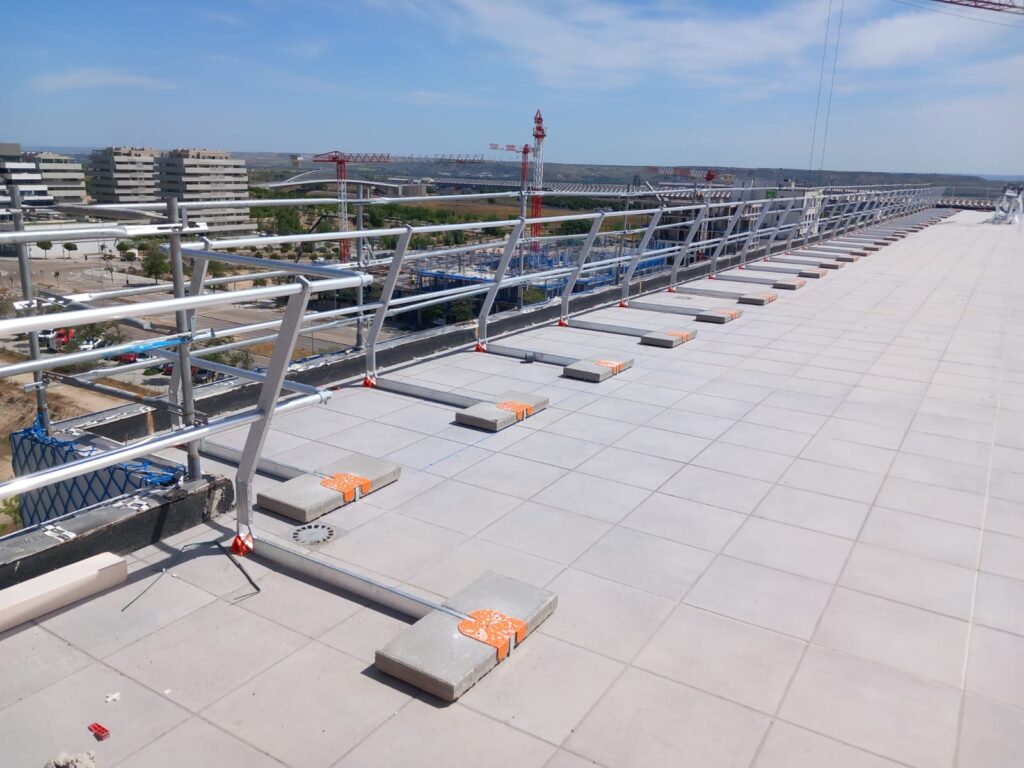
Safety guardrails at height and skylight protection mesh offer clear operational advantages:
- Continuous protection with no action required from the worker
- Elimination of reliance on the human factor to activate the protection
- Greater freedom of movement and ease of getting around
- Drastic reduction in errors resulting from incorrect use of PPE
- Increases work speed significantly by eliminating connection/disconnection times
In addition, they allow simultaneous work by different operators without the need for constant individual connections, optimizing team coordination and performance.
Training and Correct Use of PPE
Personal protective equipment remains essential in many situations where collective protection is not technically feasible:
- Rope access work
- Specific industrial maintenance
- One-off temporary access
However, having equipment certified under Regulation (EU) 2016/425, which sets out the strict health and safety requirements for its design, manufacture, and marketing and repealed the former Directive 89/686/EEC, does not guarantee safety if workers are not properly trained in its use.
Problems caused by insufficient training
Technical inspections frequently detect errors such as:
- Poorly adjusted harness or incorrect attachment points
- Improper connections to anchor points
- Incorrect use of energy absorbers
- Anchors incompatible with the system being used
- Lack of documented periodic inspections
These failures reduce the effectiveness of the systems and slow down the work.
Training as a productivity tool
A properly trained worker:
- Moves around with greater safety and confidence
- Significantly reduces execution times
- Makes fewer operational errors
- Spots risks faster
- Uses the equipment correctly
Practical, specific training for each work environment is one of the factors that most influences real operational efficiency.
Choosing the Right Equipment to Reduce Time and Errors
Not all protection systems are suitable for every installation. Choosing the right equipment directly influences:
- Operational productivity
- System durability
- Ease of maintenance
- Speed of installation
- Real safety during the work
Fall arrest systems: applications and limitations
Fall arrest systems are essential when permanent collective protection cannot be installed.
Among the most common solutions are:
- Horizontal lifelines
- Vertical lifelines
- Anchor points
- Retractable systems
For this reason, whenever technically feasible, collective protection usually offers greater overall efficiency.
Advantages of Safety Guardrails Over Other Systems
Permanent guardrails compliant with EN 14122-3 are one of the most efficient solutions for industrial roofs and technical areas.
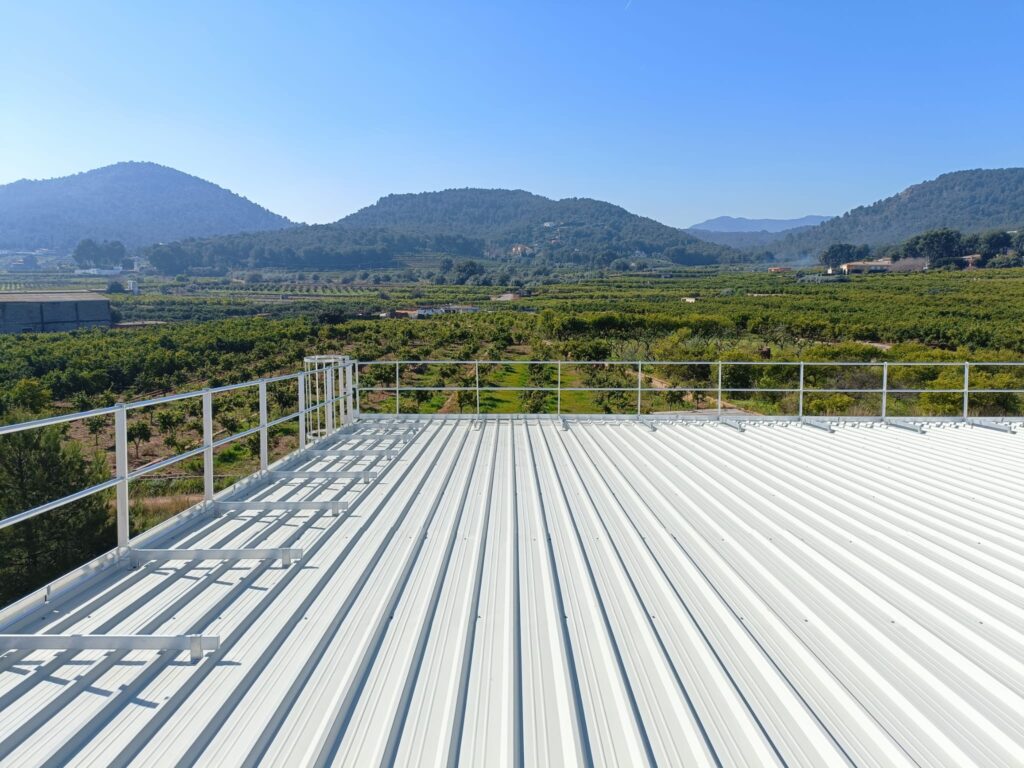
Faster interventions
Workers can access and move around without having to connect continuously, eliminating the downtime associated with:
- Locating anchor points
- Continuous connecting and disconnecting
- Checking equipment compatibility
- Repositioning the fall arrest device
Less reliance on the human factor
The protection remains continuously active and independent of the worker’s actions, eliminating the risk of forgetting to connect or connecting incorrectly.
Significant reduction in errors
- Many incidents caused by the following are eliminated:
- Incorrect use of fall arrest PPE
- Improper connections
- Incompatible equipment
- Forgetting to connect when changing position
Safety and Productivity: Inseparable Concepts
Industrial companies with the highest operational efficiency tend to share one common trait: a strong, integrated safety culture.
When safety is properly integrated at every level:
- Unplanned interruptions are reduced
- Work organization improves
- Execution errors decrease
- Staff confidence grows
- Actual working time is optimized
- Workplace climate and motivation improve
By contrast, working constantly at the limit of safety conditions tends to end up producing the opposite of the desired effect: more incidents, greater stress, loss of efficiency, and declining performance.
Conclusion
It is important to stress that improving productivity does not mean taking on more risk. In work related to safety at height, true work efficiency appears when prevention is an integral part of planning from the start of the project.
Key factors for safe efficiency
The effective combination of:
- Rigorous risk assessment at the planning stage
- Specialized training for personnel in work at height
- Correct use of suitable, certified PPE in accordance with standards
- Fall arrest systems certified by the manufacturers or by companies authorized by them
- Efficient collective protection as a preventive priority
- Documented preventive maintenance of the system used and of the work performed
Toward an optimal, efficient safety culture
The goal should be to develop fall protection solutions that improve real safety for workers without compromising companies’ operations.
Because at height, working more safely also means working more efficiently.
Safety and productivity are not opposing concepts: they are two sides of the same strategy of operational excellence that benefits both workers and the economic viability of projects.