


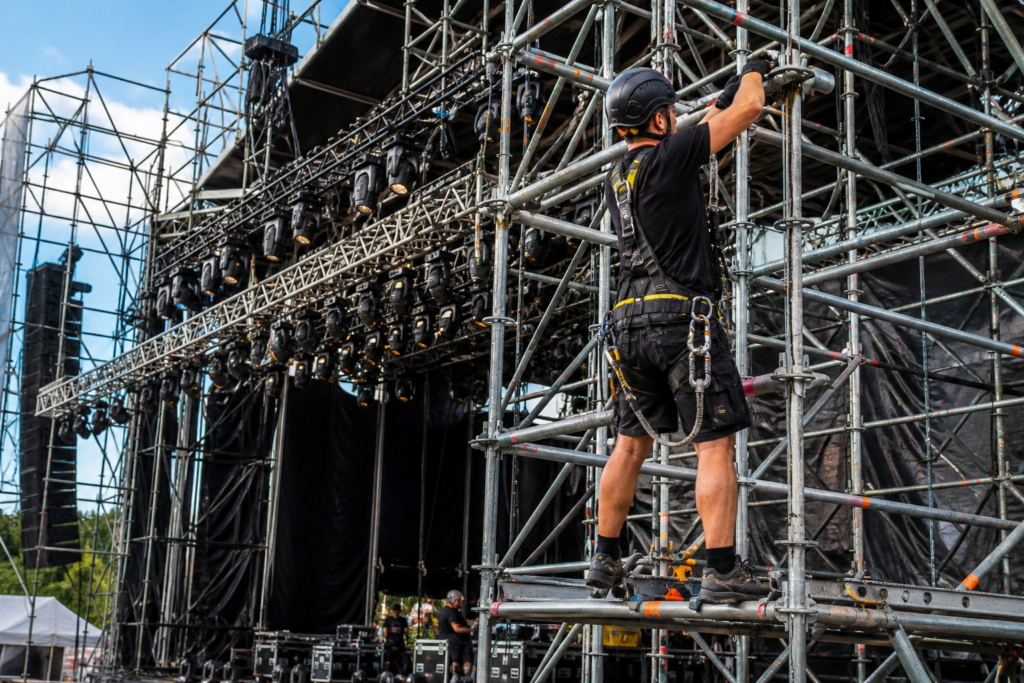
In sectors where work at height depends on summer seasons, such as events, rigging and staging, festivals, trade fairs, shows, or seasonal campaigns, occupational health and safety (OHS) is essential to prevent accidents, ensure regulatory compliance, and protect both workers and third parties.
In this article we look at the challenges these changing environments pose. For that reason, we share the keys to managing safety in work at height during events and temporary activities.
Characteristics of Work at Height at Events
In this type of environment we can find several risk factors:
- High staff turnover over very short periods, which makes it hard to build qualified teams and lowers professionalism in the sector.
- Very tight assembly and dismantling times.
- Use of temporary structures (scaffolding, aerial work platforms, towers…)
- Work areas shared among several companies or suppliers.
- Activities in unusual spaces (public spaces, exhibition grounds, etc.)
- Variable weather conditions, if the work is done outdoors.
All of this requires specific advance planning, agile but thorough, focused on controlling the risk of falling from height.
Specific Risk Assessment for Work at Height
Every event must have a specific risk assessment, especially with regard to work at height. Applying a generic assessment is not enough.
It is essential to:
- Identify work with a risk of falls (roofs, structure assembly, lighting, sound, etc.)
- Analyze the equipment used: ladders, scaffolding, lifelines, cranes, etc.
- Assess the stability of the surfaces and supporting structures.
- Take external factors into account, such as wind, rain, visibility, or interference with other work.
- Update prevention plans whenever the conditions of the event or the processes change.
Preventive measures and collective protection
As we already know, in work at height, collective protection should be prioritized over personal protection whenever possible.
- Installation of guardrails, safety nets, or technical walkways, designed to create safe passage areas.
- Use of stable, certified work platforms.
- Correct assembly and inspection of the systems by authorized, qualified personnel.
- Proper demarcation and signage of risk areas at height.
Personal protective equipment (PPE)
In work at height, it is important to use suitable PPE:
- Fall arrest devices and lifelines
- Fall arrest harness and lanyards.
- Helmets
It is essential that the equipment is certified and in good condition, that workers know how to use it correctly, and that periodic inspections are carried out before use.
Coordination of Business Activities (CAE)
When several companies take part in the same space, which is very common at events, the legal obligation for coordination of business activities (CAE) is triggered.
This involves:
- Appointing a safety officer if necessary.
- Sharing information on risks at height and preventive measures.
- Coordinating the use of structures and elevated access points.
- Making sure each company meets its OHS obligations.
Poor coordination can lead to accidents and penalties.
Specific Training and Information
In temporary work, people with little experience or no knowledge of the site are often brought in. That is why training for work at height is crucial:
- Specific training in the use of fall arrest systems and access equipment.
- Clear information on risks, safe procedures, and anchor points.
- Knowledge of emergency and evacuation plans.
It is always a good idea to hold safety talks or daily meetings to reinforce key information.
Compliance Monitoring and Supervision
During the setup, running, and teardown of the event, it is essential to supervise in real time that the preventive measures are being followed:
- Verify correct use of PPE.
- Check the stability of structures and equipment.
- Control access to elevated areas.
- Detect unsafe practices and correct them immediately.
Good supervision drastically reduces the risk of accidents.
Conclusions
Safety in work at height at temporary events must adapt to changing environments and different circumstances.
Proper planning, with an assessment of the risks we may encounter, is essential to control the hazards associated with falls from height. It also means prioritizing collective protection, ensuring the proper use of PPE, and making sure all workers are qualified to perform this work.
To prevent risks and unsafe behavior in time, constant supervision during all phases of the event is important.