


Metal meshes are used in construction, agriculture, industry, and occupational safety. Although they may look the same at first glance, they are not, and depending on how they are manufactured, they are suited to one use or another. In this article we review their characteristics, the main types, and their role in roof safety.
What is a metal mesh?
A metal mesh is a structure made of interlaced metal wires or sheets, which may be welded or punched, leaving regular openings between them. It is made of steel (galvanized, stainless or carbon), aluminium and other alloys, and it is used to enclose, protect, filter, reinforce or contain.
Features and components of a metal mesh
To choose well, it helps to know the components of a metal mesh and the characteristics of metal meshes that determine how they behave:
- Material: determines mechanical strength and corrosion resistance (galvanized steel, stainless steel or aluminium).
- Wire diameter or thickness: the thicker the wire, the greater the strength.
- Mesh aperture: the size of the clear opening between wires.
- Type of joint: welded, twisted or woven; it determines rigidity and capacity to deform.
- Surface treatment: galvanised, plastic-coated or painted finishes can extend durability.
- Supply format: rolls or panels, depending on the application.
Types of metal mesh by manufacturing method
Single-twist mesh
The wires are interlaced in a spiral forming diamonds. It is flexible, lightweight and the most economical option. It is commonly used on plots of land, in gardens or on construction sites to fence off any area.
Welded wire mesh
This mesh is made of longitudinal and transverse wires welded at every crossing, which makes it rigid and stable. It is used in concrete reinforcement, enclosures, fencing, cages and machine guarding.
Triple-twist mesh
With a three-turn twist at each joint, it forms very strong hexagons that do not unravel even if a wire breaks. It is used in gabions, slope protection and civil engineering works.
Expanded metal mesh
It is obtained by cutting and stretching a metal sheet without wasting material, so it has no joints. It is very strong and anti-slip, and it is used in walkways, platforms, enclosures and facades.
Woven mesh
Made by interlacing metal wires as in a fabric, it allows very precise apertures. It is the choice for screening, filtration and sieving in industry, mining and food processing.
Metal safety mesh for roofs and rooflights
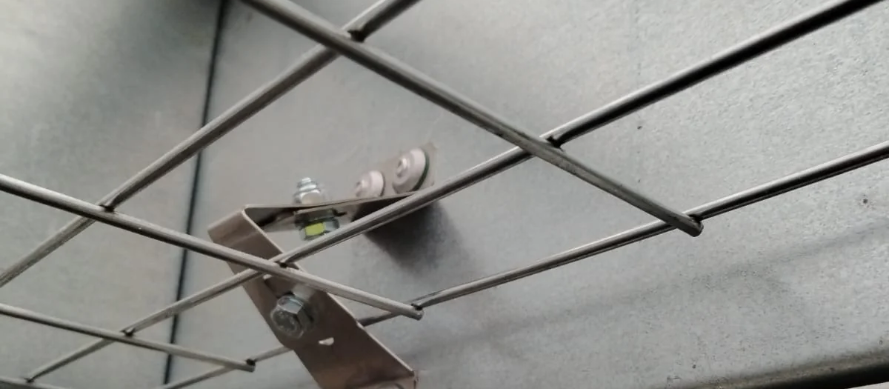
In work at height, metal safety mesh prevents falls through fragile surfaces such as rooflights, skylights or fibre cement roofs. These meshes are installed over or under the roof and must be designed to withstand the fall of a person, as well as being weather-resistant. For this reason they are made of high-strength steel with anti-corrosion treatments, and they are designed so that installation is simple and durable.
Safety meshes should not be confused with safety nets, which are two products with different functions and standards. A meshed area can also be complemented with a guardrail. The mesh protects the fragile surface and the guardrail protects the perimeter; they are compatible and provide greater protection.
PIGNUS fall arrest meshses by BY YPSOS SAFETY
Among collective protection solutions, the PIGNUS fall arrest meshes by YPSOS SAFETY, manufactured in Spain, protect fragile roof surfaces such as rooflights, skylights and translucent panels. They are designed and tested in accordance with standard UNE-EN 14963:2007, with a resistance of 1,500 J. They are made with standard hard-drawn wire of 2.05 mm and a mesh aperture of 55 mm.
They are supplied in 25 m rolls in widths of 1,250 mm and 1,500 mm, including fixings to metal sheet (minimum sheet thickness of 0.5 mm).
If you are assessing how to protect a roof, contact the YPSOS SAFETY team to choose the right model.
Frequently asked questions about types of metal mesh and their differences
By manufacturing method, the main types are welded wire mesh, single-twist mesh, triple-twist mesh, expanded metal mesh and woven mesh. They can also be grouped by use: construction, fencing, filtering or safety.
There is no fixed number, as it depends on the classification criterion. By manufacturing method there are five main families, and within each one the material, wire gauge and mesh aperture or pitch vary.
They are named either after their manufacturing method (welded, twisted, expanded, woven) or after their use or application (livestock mesh, gabion mesh, fall arrest mesh, etc.).